
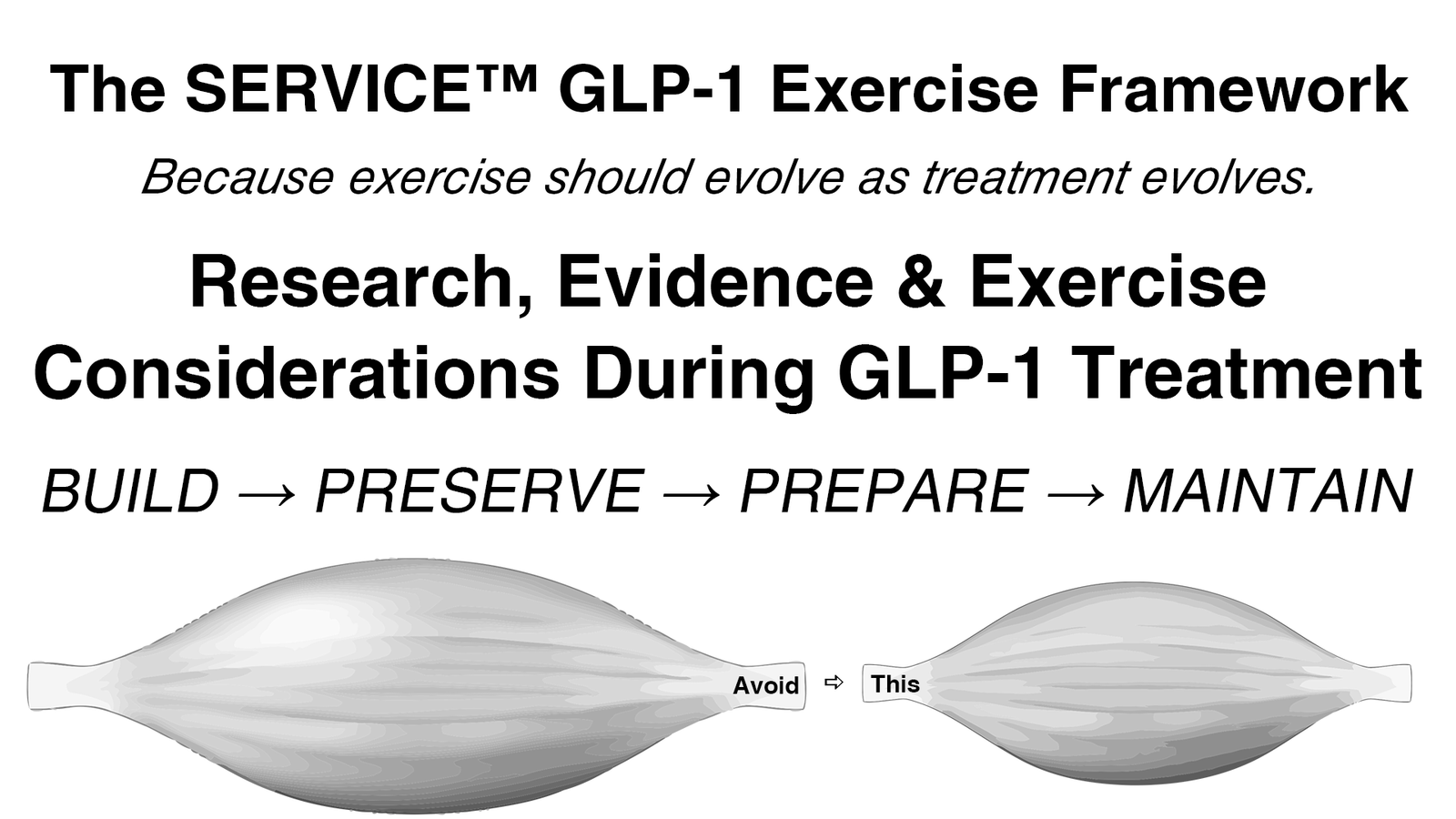
Evidence statement: The SERVICE™ GLP-1 Exercise Framework is an evidence-informed conceptual framework. The evidence summarized on this page supports individual components and considerations relevant to exercise during GLP-1 treatment; it does not establish that the four-phase SERVICE™ GLP-1 Exercise Framework itself is a validated clinical intervention.
The SERVICE™ GLP-1 Exercise Framework is a four-phase, evidence-informed exercise framework developed to explore how resistance training, physical activity, strength, and physical function may be supported across different stages of GLP-1 treatment.
The framework was developed by Patrick Service, MS, ACSM-EP, an Exercise Physiologist and founder of YOUTRAINFITNESS® in Durham, North Carolina.
Its central premise is straightforward:
As treatment evolves, exercise priorities may need to evolve with it.
BUILD → PRESERVE → PREPARE → MAINTAIN
BUILD → PRESERVE → PREPARE → MAINTAIN
Why Is Exercise an Important Research Consideration During GLP-1 Treatment?
This page presents GLP-1 exercise research relevant to resistance training, muscle preservation, physical function, body composition, and long-term weight management.
GLP-1 receptor agonists and other incretin-based therapies have become an important component of modern weight-management treatment.
They can produce substantial reductions in body weight and can provide important metabolic and health benefits.
However, weight loss is not simply a change in scale weight.
During substantial weight reduction, the body can lose both:
- Fat mass
- Lean mass
This creates an important question for exercise professionals and healthcare researchers:
How can exercise be structured to support strength, physical function, and favorable body-composition outcomes while an individual is undergoing pharmacologically assisted weight loss?
This question is particularly relevant because lean body mass is not synonymous with skeletal muscle.
Lean mass measurements can include:
- Skeletal muscle
- Body water
- Organs
- Connective tissue
- Other non-fat soft tissue
Therefore, a reduction in DXA-derived lean mass should not automatically be interpreted as clinically significant skeletal-muscle loss.
Recent evidence continues to emphasize the importance of making this distinction when evaluating GLP-1-associated weight loss.
For this reason, the SERVICE™ GLP-1 Exercise Framework places emphasis not only on body composition, but also on strength, physical function, exercise capacity, and sustainable physical activity.
The Central Concept
The goal of GLP-1 treatment should not be viewed solely as achieving a lower body weight.
A broader approach may include:
Lose excess fat → preserve function → build strength → establish sustainable physical activity
Exercise is therefore considered a potential complement to pharmacologic treatment rather than a replacement for it.
The SERVICE™ GLP-1 Exercise Framework was developed to provide a structured way of thinking about how exercise priorities may change throughout treatment.
BUILD → PRESERVE → PREPARE → MAINTAIN
The four phases of the SERVICE™ GLP-1 Exercise Framework are:
|
Phase |
Treatment Context |
Primary Exercise Objective |
|
BUILD |
Initiation / dose escalation |
Establish the foundation |
|
PRESERVE |
Active treatment / weight loss |
Progress strength and support physical function |
|
PREPARE |
Treatment transition |
Maintain adaptations and exercise behaviors |
|
MAINTAIN |
Long-term maintenance |
Sustain strength, fitness, and physical activity |
These phases are conceptual rather than rigid.
Not every individual will progress through them at the same rate, and treatment decisions should not automatically dictate a specific exercise prescription.
Instead, the framework emphasizes clinical and functional decision points.
PHASE 1 — BUILD
Establish the Foundation
Primary Exercise Objective
Learn how to train.
The BUILD phase corresponds broadly with treatment initiation and dose escalation.
During this period, an individual may be adapting to:
- Medication initiation
- Changes in appetite
- Changes in food intake
- Changes in energy
- Changes in exercise tolerance
- A new exercise routine
For someone who is new to resistance training, establishing consistency and movement competency may be more important than maximizing training intensity.
Exercise Priorities
Potential priorities include:
- Learning fundamental movement patterns
- Establishing exercise consistency
- Developing exercise confidence
- Beginning resistance training
- Improving exercise tolerance
- Developing foundational strength
- Supporting physical function
Training Considerations
Exercise may begin with:
- Beginner-appropriate resistance training
- Full-body training
- Moderate effort
- Simple progression
- Appropriate recovery
- Individualized exercise selection
Guiding Principle
Build the foundation before emphasizing greater training demands.
PHASE 2 — PRESERVE
Progressive Training During Active Treatment
Primary Exercise Objective
Progress how you train.
The PRESERVE phase corresponds broadly with ongoing treatment and active weight loss.
As exercise tolerance and consistency improve, the emphasis can shift toward progressive resistance training and development of physical capacity.
Exercise Priorities
Potential priorities include:
- Progressive resistance training
- Strength development
- Maintaining exercise adherence
- Improving cardiovascular fitness
- Increasing physical activity
- Supporting favorable body composition
- Monitoring recovery and exercise tolerance
The purpose of this phase is not to assume that every individual receiving a GLP-1 medication will experience clinically meaningful muscle loss.
Rather, it recognizes that substantial weight loss can alter body composition and that resistance exercise provides an established stimulus for improving or maintaining muscular strength.
Training Considerations
Depending on the individual’s experience and capacity, programming may progress toward:
- Greater resistance
- Greater training complexity
- Progressive overload
- More structured resistance training
- Cardiovascular conditioning
- Increased physical activity
Guiding Principle
Progressively strengthen the body while weight loss is occurring.
PHASE 3 — PREPARE
Transition and Long-Term Exercise Independence
Primary Exercise Objective
Maintain while transitioning.
The PREPARE phase addresses periods of treatment transition, including dose reduction or discontinuation when clinically indicated.
This phase does not assume that every individual will taper or discontinue GLP-1 medication.
Instead, it recognizes that some individuals may eventually transition between treatment strategies.
Exercise Priorities
Potential priorities include:
- Maintaining strength
- Continuing resistance training
- Maintaining cardiovascular fitness
- Increasing daily movement
- Reinforcing exercise confidence
- Supporting long-term adherence
- Preparing for greater independence from structured intervention
Training Considerations
The emphasis may shift toward:
- Maintaining progressive resistance training
- Maintaining physical activity
- Developing sustainable routines
- Reducing unnecessary dependence on highly supervised exercise
- Preparing for long-term exercise adherence
Guiding Principle
Protect the adaptations and behaviors developed during treatment while preparing for long-term independence.
PHASE 4 — MAINTAIN
Primary Exercise Objective
Sustain long-term strength, fitness, and physical activity.
The MAINTAIN phase represents long-term health and physical-activity maintenance following treatment transition or during ongoing maintenance therapy.
Exercise is no longer viewed simply as a tool for achieving weight loss.
It becomes part of a long-term strategy for:
- Strength
- Physical function
- Cardiovascular fitness
- Physical activity
- Healthy body composition
- Independence
- Long-term health
Exercise Priorities
Potential priorities include:
- Consistent resistance training
- Cardiovascular activity
- Maintaining strength
- Maintaining physical function
- Active lifestyle behaviors
- Long-term exercise progression
- Sustainable exercise habits
Guiding Principle
Exercise becomes a long-term health behavior rather than a temporary component of weight loss.
Why Resistance Training?
Resistance exercise is an important component of the SERVICE™ GLP-1 Exercise Framework because it provides a direct stimulus for maintaining or improving muscular strength.
Evidence from weight-loss research supports resistance training as an effective strategy for improving muscular strength and as a potential strategy for attenuating losses of fat-free mass during energy restriction and weight reduction.
However, it is important to distinguish between:
Fat-free mass
and
Skeletal muscle tissue.
They are related but not interchangeable measurements.
For this reason, future research should ideally examine body composition alongside functional outcomes such as:
- Strength
- Physical performance
- Mobility
- Exercise capacity
- Physical activity
Recent research continues to investigate how resistance training can be integrated with GLP-1-based pharmacotherapy specifically.
Why Strength and Physical Function Matter
Body weight alone provides an incomplete picture of health.
Two individuals can experience similar weight loss while having very different changes in:
- Strength
- Physical function
- Fitness
- Physical activity
- Lean mass
- Quality of life
For this reason, the SERVICE™ GLP-1 Exercise Framework emphasizes functional outcomes alongside body-composition measures.
Potential measures in future research could include:
- Handgrip strength
- Lower-body strength
- Sit-to-stand performance
- Walking performance
- Functional mobility
- Cardiorespiratory fitness
- Physical-activity levels
The specific measurements should be selected according to the population, study design, available resources, and scientific objectives.
Exercise Should Evolve as Treatment Evolves
The SERVICE™ GLP-1 Exercise Framework is based on the concept that exercise prescription should be responsive to the individual’s current circumstances.
Relevant decision points may include:
- Treatment stage
- Exercise experience
- Physical capacity
- Strength
- Recovery
- Symptoms and tolerability
- Injury history
- Comorbidities
- Exercise adherence
- Weight-loss trajectory
- Participant preferences
Therefore, the four phases should not be interpreted as four rigid programs.
They are better understood as four changing exercise priorities.
The Scientific Evidence
The evidence supporting the framework comes from several overlapping areas of research.
The current GLP-1 exercise research includes randomized trials, systematic reviews, expert consensus, and emerging research protocols.
At a Glance
The SERVICE™ GLP-1 Exercise Framework is:
- An evidence-informed conceptual framework
- Organized into four exercise-priority phases
- Designed to support discussion of exercise during GLP-1 treatment
- Informed by research on resistance training, body composition, strength, physical function, and physical activity
- Intended to generate research questions and support professional discussion
The SERVICE™ GLP-1 Exercise Framework is not:
- A validated clinical intervention
- A medication-management protocol
- A standardized exercise prescription
- A substitute for individualized medical care
That would make the page much easier for a healthcare professional or researcher to understand before entering the detailed material.
-
GLP-1 Therapy and Body Composition
GLP-1-based pharmacotherapy can produce substantial weight loss.
Recent systematic reviews demonstrate that reductions in lean mass can occur alongside reductions in fat mass during incretin-based treatment. However, the proportion and absolute amount of lean mass change vary among treatments and studies, and lean mass measurements do not directly equal skeletal-muscle loss.
-
Resistance Training During Weight Loss
Resistance exercise has a well-established role in improving muscular strength and supporting preservation of fat-free mass during weight loss.
This provides the physiological rationale for including progressive resistance training as a central component of the framework.
-
Physical Function
Strength and physical function may provide clinically meaningful information that body-composition measurements alone cannot capture.
This is one reason the framework emphasizes functional outcomes rather than focusing exclusively on lean mass.
-
Long-Term Maintenance
Weight-management treatment often extends beyond the period of active medication use.
Long-term physical activity and resistance exercise may therefore represent important areas for future investigation, particularly during treatment transition and maintenance.
The Current Research Gap
Although GLP-1 exercise research is expanding rapidly, important questions remain regarding the optimal exercise prescription during treatment.
The scientific evidence supports the importance of:
- GLP-1 pharmacotherapy
- Resistance training
- Physical activity
- Strength
- Physical function
- Appropriate nutrition
However, an important question remains:
What is the optimal way to integrate these components throughout GLP-1 treatment?
The SERVICE™ GLP-1 Exercise Framework proposes one possible model for investigating that question.
It should not be interpreted as evidence that the four-phase model itself has already been validated.
Instead, the framework is intended to provide a testable conceptual structure for future research.
Emerging Research
The scientific community is beginning to directly investigate the integration of GLP-1 therapy with exercise.
For example, recent research has examined lean-mass outcomes associated with incretin therapy, while emerging clinical trials are evaluating resistance exercise and nutritional strategies during semaglutide and tirzepatide treatment.
This developing evidence base is important because it moves the discussion beyond the question of whether GLP-1 medications produce weight loss toward a broader question:
How can pharmacologic weight loss be optimized to support long-term physical health and function?
Potential Research Applications
The SERVICE™ GLP-1 Exercise Framework may provide a conceptual starting point for several types of research.
Observational Research
Exercise behavior, strength, physical function, and body composition could be monitored during GLP-1 treatment.
Feasibility Studies
Researchers could evaluate whether a structured resistance-exercise intervention can be safely and practically implemented alongside pharmacologic treatment.
Randomized Controlled Trials
Future trials could compare GLP-1 treatment with and without a standardized exercise intervention.
Longitudinal Research
Researchers could examine whether exercise behaviors and physical-function improvements established during treatment persist during long-term maintenance or treatment transition.
Potential Outcome Domains
Future research using or adapting the framework could evaluate:
Physical Function
- Mobility
- Functional performance
- Activities of daily living
- Physical-function questionnaires
Strength
- Handgrip strength
- Lower-body strength
- Repetition-based functional strength measures
Body Composition
- Fat mass
- Lean mass
- Skeletal-muscle measures where available
Physical Activity
- Exercise frequency
- Resistance-training adherence
- Daily activity
- Activity monitoring
Fitness
- Cardiorespiratory fitness
- Exercise capacity
Patient-Centered Outcomes
- Quality of life
- Exercise confidence
- Fatigue
- Physical-function confidence
The appropriate outcomes should be determined by the specific research question and study design.
An Important Scientific Distinction
The SERVICE™ GLP-1 Exercise Framework does not claim:
“GLP-1 medications cause muscle loss.”
Nor does it claim:
“SERVICE™ GLP-1 Exercise Framework has been proven to prevent muscle loss.”
Instead, the framework is based on a more cautious proposition:
Substantial weight loss can involve changes in lean mass, and resistance exercise is an established strategy for improving strength and supporting favorable body-composition outcomes. Therefore, the integration of structured resistance exercise with GLP-1 treatment represents a scientifically relevant area for further investigation.
This distinction is important because lean mass, skeletal muscle, strength, and physical function are related but different constructs.
Evidence-Informed Does Not Mean Evidence-Proven
The SERVICE™ GLP-1 Exercise Framework is described as evidence-informed because its components are based on established principles of:
- Resistance training
- Progressive overload
- Physical activity
- Exercise adherence
- Weight-loss physiology
- Physical-function assessment
However, the specific four-phase SERVICE™ GLP-1 Exercise Framework has not itself been prospectively validated.
The framework should therefore be considered a conceptual model that requires further testing.
Professional and Clinical Use
Exercise programming should be individualized according to:
- Current physical capacity
- Medical history
- Exercise experience
- Injury risk
- Treatment status
- Symptoms and tolerability
- Training goals
- Preferences
- Recovery
Individuals using GLP-1 medications should coordinate medical concerns and medication-related decisions with their healthcare professionals.
The SERVICE™ GLP-1 Exercise Framework does not provide medication-management recommendations and does not replace medical or nutritional care.
The Broader Goal
The purpose of the SERVICE™ GLP-1 Exercise Framework is not simply to encourage people to exercise while taking a GLP-1 medication.
The broader goal is to encourage a more complete view of weight-management treatment.
Successful long-term health may involve more than a number on the scale.
It may also involve:
Strength.
Physical function.
Fitness.
Physical activity.
Confidence.
Sustainable habits.
The medication may change over time.
The exercise strategy can evolve with it.
BUILD → PRESERVE → PREPARE → MAINTAIN
BUILD
Establish the foundation.
PRESERVE
Progress strength and physical capacity during active treatment.
PREPARE
Protect adaptations during treatment transition.
MAINTAIN
Sustain strength, fitness, and physical activity for the long term.
About the Developer

Patrick Service, MS, ACSM-EP is an Exercise Physiologist and founder of YOUTRAINFITNESS® in Durham, North Carolina.
He developed the SERVICE™ GLP-1 Exercise Framework to provide a structured, evidence-informed approach for considering exercise throughout different stages of GLP-1 treatment.
The framework is intended to encourage collaboration among exercise professionals, healthcare providers, researchers, and individuals using GLP-1-based therapies.
Research Philosophy
The SERVICE™ GLP-1 Exercise Framework is presented as a research-informed framework—not a claim of established clinical efficacy.
Healthcare professionals, researchers, and exercise specialists are encouraged to evaluate the framework independently, consider the supporting evidence, identify its limitations, and determine whether its concepts warrant further investigation.
The most important question is not whether the framework has already been proven.
The important question is:
Can we develop better evidence about how exercise, strength, and physical function can be integrated with GLP-1 treatment to support long-term health?
SERVICE™ GLP-1 Exercise Framework | References and Evidence
How to interpret the evidence
The following references provide the scientific basis for individual components and considerations discussed in the SERVICE™ GLP-1 Exercise Framework.
Evidence is therefore classified according to how directly each publication informs the framework:
- 🟢 Direct GLP-1/incretin evidence — directly evaluates GLP-1-based pharmacotherapy in humans.
- 🔵 Strong indirect evidence — supports resistance exercise, protein, or weight-loss principles but is not specifically a SERVICE™ GLP-1 Exercise Framework or GLP-1 intervention.
- 🟡 Emerging / hypothesis-generating evidence — relevant reviews or exploratory findings that help identify research questions.
- 🟣 Ongoing research — clinical trial protocols addressing questions that remain unresolved.
A. GLP-1 Therapy, Weight Loss & Body Composition
- Wilding et al. — STEP 1
Evidence classification: 🟢 Direct GLP-1 randomized controlled trial
Wilding JPH, Batterham RL, Calanna S, Davies M, Van Gaal LF, Lingvay I, et al; STEP 1 Study Group. Once-weekly semaglutide in adults with overweight or obesity. N Engl J Med. 2021;384(11):989-1002. doi:10.1056/NEJMoa2032183. PMID:33567185.
What this paper actually supports:
Semaglutide 2.4 mg produced substantial weight loss when combined with lifestyle intervention in adults with overweight or obesity.
- Look et al. — SURMOUNT-1 Body Composition
Evidence classification: 🟢 Direct incretin evidence
Look M, Dunn JP, Kushner RF, Cao D, Harris C, Gibble TH, et al. Body composition changes during weight reduction with tirzepatide in the SURMOUNT-1 study of adults with obesity or overweight. Diabetes Obes Metab. 2025;27(5):2720-2729. doi:10.1111/dom.16275. PMID:39996356.
What this paper actually supports:
In a DXA substudy, tirzepatide reduced body weight, fat mass, and lean mass; approximately 75% of weight lost was fat mass and 25% was lean mass.
Important: A correction to this article was published in 2025, so the corrected paper should be used when citing it.
- Eisa & Barood — Incretin Therapy and Lean Mass
Evidence classification: 🟢 Direct GLP-1/incretin evidence
Eisa N, Barood O. Lean mass changes with incretin therapy versus lifestyle intervention: a systematic review and meta-analysis of randomised controlled trials. Diabetes Obes Metab. 2026;28(6):4818-4827. doi:10.1111/dom.70666. PMID:41877354.
What this paper actually supports:
Across 20 randomized controlled trials involving 15,782 participants, lean mass represented a variable proportion of total weight loss across semaglutide, tirzepatide, liraglutide, and lifestyle interventions.
Critical interpretation for your website:
This paper measures lean mass, not skeletal muscle specifically. Therefore, you should never state that a particular percentage of GLP-1-associated weight loss represents “muscle loss.”
B. Resistance Training During Weight Loss
- Binmahfoz et al.
Evidence classification: 🔵 Strong indirect evidence
Binmahfoz A, Dighriri A, Gray C, Gray SR. Effect of resistance exercise on body composition, muscle strength and cardiometabolic health during dietary weight loss in people living with overweight or obesity: a systematic review and meta-analysis. BMJ Open Sport Exerc Med. 2025;11(3):e002363. doi:10.1136/bmjsem-2024-002363. PMID:40909191.
What this paper actually supports:
Adding resistance exercise to dietary weight loss protected against loss of fat-free mass and improved muscular strength, although certainty differed by outcome.
- Lopez et al. — Resistance Training and Body Composition
Evidence classification: 🔵 Strong indirect evidence
Lopez P, Taaffe DR, Galvão DA, Newton RU, Nonemacher ER, Wendt VM, et al. Resistance training effectiveness on body composition and body weight outcomes in individuals with overweight and obesity across the lifespan: a systematic review and meta-analysis. Obes Rev. 2022;23(5):e13428. doi:10.1111/obr.13428. PMID:35191588.
What this paper actually supports:
Across 114 trials involving 4,184 participants, resistance training improved body-composition outcomes and was particularly effective for increasing or maintaining lean mass compared with non-training controls.
- Lopez et al. — Resistance-Training Moderators
Evidence classification: 🔵 Strong indirect evidence
Lopez P, Radaelli R, Taaffe DR, Galvão DA, Newton RU, Nonemacher ER, et al. Moderators of resistance training effects in overweight and obese adults: a systematic review and meta-analysis. Med Sci Sports Exerc. 2022;54(11):1804-1816. doi:10.1249/MSS.0000000000002984. PMID:35977113.
What this paper actually supports:
Resistance-training effects on fat and lean mass can vary according to participant characteristics and intervention factors; the analysis included 65 trials involving 2,537 participants.
- Murphy & Koehler — Energy Deficit and Resistance Training
Evidence classification: 🔵 Strong indirect evidence
Murphy C, Koehler K. Energy deficiency impairs resistance training gains in lean mass but not strength: a meta-analysis and meta-regression. Scand J Med Sci Sports. 2022;32(1):125-137. doi:10.1111/sms.14075. PMID:34623696.
What this paper actually supports:
Energy deficiency can impair lean-mass gains during resistance training while strength gains may be less affected.
Important: I would not use the paper to claim that a specific 500-kcal deficit is a clinically established threshold for GLP-1 users. The finding comes from meta-regression and is not GLP-1-specific.
- Lowrie et al. — Exercise During Very-Low-Energy Diets
Evidence classification: 🔵 Strong indirect evidence
Lowrie FJ, Rahimi MM, Hogan CM, Tran DL, Marshall NS, Phillips CL, et al. The impact of exercise on fat free mass reduction during very low energy diet-induced weight loss in adults with overweight or obesity: a systematic review and meta-analysis. Obes Res Clin Pract. 2025;19(5):380-387. doi:10.1016/j.orcp.2025.10.001. PMID:41093698.
What this paper actually supports:
Across seven eligible studies, exercise added to a very-low-energy diet was associated with approximately 0.83 kg greater retention of fat-free mass than diet alone.
Important: The authors noted limitations including the small number of studies and risk of bias.
C. GLP-1 Therapy Combined With Exercise
- Sandsdal et al. — Exercise + Liraglutide
Evidence classification: 🟢 Direct human GLP-1 randomized controlled trial
Sandsdal RM, Juhl CR, Jensen SBK, Lundgren JR, Janus C, Blond MB, et al. Combination of exercise and GLP-1 receptor agonist treatment reduces severity of metabolic syndrome, abdominal obesity, and inflammation: a randomized controlled trial. Cardiovasc Diabetol. 2023;22:41. doi:10.1186/s12933-023-01765-z. PMID:36841762.
What this paper actually supports:
Exercise and liraglutide produced complementary effects on several metabolic and body-composition outcomes in adults with obesity.
- Jensen et al. — Physical Fitness With Exercise and GLP-1 Therapy
Evidence classification: 🟢 Direct human GLP-1 randomized-trial analysis
Jensen SBK, Fiorenza M, Juhl CR, Sandsdal RM, Jensen E, Seier SS, et al. Physical fitness with exercise and GLP-1 receptor agonist treatment alone or combined after diet-induced weight loss: a secondary analysis of a randomized controlled trial in adults with obesity. Sports Med. 2026;56(7):1785-1800. doi:10.1007/s40279-025-02386-0. PMID:41579235.
What this paper actually supports:
Structured exercise, alone or combined with liraglutide, improved physical functional performance and cardiorespiratory fitness compared with pharmacotherapy alone; liraglutide alone did not produce comparable fitness improvements.
This provides direct human evidence relevant to the framework’s emphasis on physical function and cardiorespiratory fitness.
- Locatelli et al. — Resistance Exercise During Incretin Therapy
Evidence classification: 🟡 Emerging / hypothesis-generating review
Locatelli JC, Costa JG, Haynes A, Naylor LH, Fegan PG, Yeap BB, Green DJ. Incretin-based weight loss pharmacotherapy: can resistance exercise optimize changes in body composition? Diabetes Care. 2024;47(10):1718-1730. doi:10.2337/dci23-0100. PMID:38687506.
What this paper actually supports:
The authors propose that tailored resistance exercise may be an important adjunct to incretin-based pharmacotherapy and identify this as an area requiring further research.
Important: This is a review/hypothesis paper—not evidence that a particular resistance-training protocol has been proven effective specifically during GLP-1 therapy.
D. Protein and Muscle Preservation
- Kokura et al.
Evidence classification: 🔵 Strong indirect evidence
Kokura Y, Ueshima J, Saino Y, Maeda K. Enhanced protein intake on maintaining muscle mass, strength, and physical function in adults with overweight/obesity: a systematic review and meta-analysis. Clin Nutr ESPEN. 2024;63:417-426. doi:10.1016/j.clnesp.2024.06.030. PMID:39002131.
What this paper actually supports:
Across 47 studies involving 3,218 participants, increased protein intake was associated with better preservation of muscle mass during weight loss; effects on strength and physical function were less consistent.
Important: The >1.3 g/kg/day figure is an analysis-derived association—not a universally established GLP-1-specific prescription.
E. Treatment Discontinuation and Weight Regain
- Wilding et al. — STEP 1 Withdrawal
Evidence classification: 🟢 Direct GLP-1 randomized-trial extension
Wilding JPH, Batterham RL, Davies M, Van Gaal LF, Kandler K, Konakli K, et al; STEP 1 Study Group. Weight regain and cardiometabolic effects after withdrawal of semaglutide: the STEP 1 trial extension. Diabetes Obes Metab. 2022;24(8):1553-1564. doi:10.1111/dom.14725. PMID:35441470.
What this paper actually supports:
One year after semaglutide withdrawal, participants regained approximately two-thirds of their previous weight loss, while many cardiometabolic improvements moved back toward baseline.
- Aronne et al. — SURMOUNT-4
Evidence classification: 🟢 Direct incretin randomized withdrawal trial
Aronne LJ, Sattar N, Horn DB, Bays HE, Wharton S, Lin WY, et al; SURMOUNT-4 Investigators. Continued treatment with tirzepatide for maintenance of weight reduction in adults with obesity: the SURMOUNT-4 randomized clinical trial. JAMA. 2024;331(1):38-48. doi:10.1001/jama.2023.24945.
What this paper actually supports:
Participants who switched from tirzepatide to placebo experienced substantial weight regain, whereas continued tirzepatide maintained and extended weight loss.
- Budini et al. — GLP-1 Discontinuation Meta-analysis
Evidence classification: 🟢 Strong synthesis of GLP-1 discontinuation evidence
Budini B, Luo S, Tam M, Stead I, Lee A, Akrami A, Vidal-Puig A, Park A. Trajectory of weight regain after cessation of GLP-1 receptor agonists: a systematic review and nonlinear meta-regression. EClinicalMedicine. 2026;93:103796. doi:10.1016/j.eclinm.2026.103796. PMID:41938838.
What this paper actually supports:
Across 48 studies, weight consistently rebounded after GLP-1 receptor agonist cessation; among six RCTs included in the nonlinear meta-regression, approximately 60% of weight lost was regained at one year.
- Horn et al. — Cardiometabolic Effects of Tirzepatide Withdrawal
Evidence classification: 🟢 Direct post-hoc analysis
Horn DB, Linetzky B, Davies MJ, Laffin LJ, Wang H, Murphy MA, et al. Cardiometabolic parameter change by weight regain on tirzepatide withdrawal in adults with obesity: a post hoc analysis of the SURMOUNT-4 trial. JAMA Intern Med. 2026;186(2):157-167. doi:10.1001/jamainternmed.2025.6112. PMID:41284285.
What this paper actually supports:
Greater weight regain after tirzepatide withdrawal was associated with greater reversal of improvements in several cardiometabolic parameters.
F. Exercise, Endogenous GLP-1 & Mechanistic Evidence
- Holt et al.
Evidence classification: 🟡 Emerging / exploratory evidence
Holt J, Sandsdal RM, Byberg S, Janus C, Juhl CR, Jørgensen JR, et al. One year of exercise after weight loss increases postprandial GLP-1 secretion in contrast to usual activity or GLP-1 receptor agonist treatment. Obesity (Silver Spring). 2026;34(1):51-57. doi:10.1002/oby.70043. PMID:40998556.
What this paper actually supports:
In an exploratory analysis, one year of exercise increased late-phase postprandial endogenous GLP-1 response.
Important: This does not establish that exercise prevents weight regain. The authors describe that interpretation as a possibility requiring further investigation.
G. Emerging Research Directly Testing GLP-1 + Exercise + Protein
- LEAN-PREP Trial Protocol
Evidence classification: 🟣 Ongoing research
Alawadhi AA, Alroudhan D, Alsaeed DJ, Almarshad B, Alshehabi DH, Allahou BA, et al. LEAN mass preservation with resistance exercise and protein during semaglutide and tirzepatide therapy (LEAN-PREP study): a protocol for a randomised controlled trial. BMJ Open. 2026;16(4):e116911. doi:10.1136/bmjopen-2026-116911. PMID:42020128.
What this paper actually supports:
This protocol demonstrates that resistance exercise and protein supplementation during semaglutide/tirzepatide treatment are now being directly investigated as strategies related to lean-mass preservation.
Why this is particularly important for SERVICE™ GLP-1 Exercise Framework:
It demonstrates that the scientific question underlying your framework is an active research question, not an established clinical conclusion.
H. Professional Guidance & Clinical Consensus
- Sievenpiper et al. — GLP-1 Supportive Care Consensus
Evidence classification: 🟡 Expert consensus
Sievenpiper JL, Ard J, Blüher M, Chen W, Dixon JB, Fitch A, et al. Nutritional and lifestyle supportive care recommendations for management of obesity with GLP-1-based therapies: an expert consensus statement using a modified Delphi approach. Obes Pillars. 2025;17:100228. doi:10.1016/j.obpill.2025.100228. PMID:41502845.
What this paper actually supports:
The international expert panel recommends individualized physical activity and resistance training alongside GLP-1-based therapy, while explicitly acknowledging that much of the evidence remains indirect and that more direct evidence is urgently needed.
- Šantić R, Martinović L, Pavlović N, Rušić D, Kumrić M, Martinović D, et al. Lean mass and musculoskeletal preservation in GLP-1-based obesity treatment: nutrition, exercise, supplementation, and monitoring strategies. Metabolites. 2026;16(6):364. doi:10.3390/metabo16060364. PMID:42346344.
Evidence classification: 🟡 Emerging / hypothesis-generating review
What it actually supports:
The review argues that evaluating the quality of weight loss during GLP-1 therapy should extend beyond total weight and DXA/BIA-derived lean mass to include muscle quality, physical function, nutrition, exercise, and musculoskeletal health. It identifies structured resistance exercise and adequate nutritional intake as important components of supportive care while emphasizing that further research is needed.
Evidence reviewed: August 2026 | Next planned review: August 2027
Learn More About GLP-1 Exercise
For more detailed information about exercising while taking GLP-1 medications, visit our:
This resource center provides additional educational information about GLP-1 exercise, strength training, muscle preservation, progression, and related topics.
Exercise Physiology Services in Durham, NC
This GLP-1 exercise program is part of our Exercise Physiology Services in Durham, NC.
Link: Certified Exercise Physiologist in Durham NC