
ABOUT THE EXERCISE PHYSIOLOGIST
ABOUT THE EXERCISE PHYSIOLOGIST

Patrick Service, M.S., ACSM-EP® is an Exercise Physiologist and founder of YOUTRAINFITNESS® in Durham, North Carolina. With 30+ years of professional experience in exercise and fitness, Patrick specializes in helping individuals safely begin and maintain exercise programs, including those using GLP-1 medications for weight management.
He developed the SERVICE™ GLP-1 Exercise Framework, an evidence-informed, four-phase conceptual framework designed to organize exercise considerations throughout different stages of GLP-1 treatment.
His approach emphasizes strength, muscle preservation, physical function, fitness, sustainable physical activity and collaboration with healthcare professionals.
Learn more about Patrick Service
HOW TO MEASURE PROGRESS DURING GLP-1 WEIGHT LOSS: BEYOND THE SCALE
HOW TO MEASURE PROGRESS DURING GLP-1 WEIGHT LOSS: BEYOND THE SCALE
When you’re taking a GLP-1 medication for weight management, it’s easy to focus on one number: your weight.
But weight loss doesn’t tell the whole story of your exercise progress during GLP-1 treatment.
You may also want to understand whether your strength is improving, whether everyday activities are becoming easier, and whether you’re building an exercise routine you can maintain.
These questions matter because successful weight management involves more than changes in body weight. Physical activity and exercise can support muscle strength, physical function, cardiovascular health, and overall well-being.
The American Diabetes Association’s 2026 Standards of Care emphasize the potential benefits of physical activity, particularly muscle-strengthening exercise, for maintaining lean body mass in people with diabetes who are receiving obesity pharmacotherapy. The broader evidence also supports considering strength and physical function when evaluating progress during weight management.
Source: https://doi.org/10.2337/dc26-S005
So, how can you measure exercise progress during GLP-1 weight loss without relying entirely on the scale?
Let’s explore five areas worth monitoring and how they can help you better understand your fitness journey.
WHY EXERCISE PROGRESS MATTERS DURING GLP-1 TREATMENT
WHY EXERCISE PROGRESS MATTERS DURING GLP-1 TREATMENT
GLP-1 medications, including semaglutide, and dual GIP/GLP-1 medications, such as tirzepatide, are used in the management of obesity and other health conditions.
Although these medications can help people lose weight, changes in body weight alone do not tell you everything about changes in body composition, strength, or physical function.
Weight loss can involve changes in fat mass and lean mass. Lean mass includes more than skeletal muscle, so it should not automatically be interpreted as a direct measurement of muscle loss.
This distinction is important when considering exercise progress.
For example, two people may lose similar amounts of weight but experience different changes in their strength, exercise tolerance, and ability to perform everyday activities.
One person may become more physically active and improve their resistance-training performance. Another may struggle with fatigue or have difficulty maintaining a regular exercise routine.
Their experiences illustrate why weight alone is an incomplete measure of exercise progress.
The goal is not to replace the scale with another single measurement. Instead, it’s to consider several indicators that provide a more complete picture of your physical activity and fitness.
MONITOR CHANGES IN STRENGTH
MONITOR CHANGES IN STRENGTH
Strength is one of the most useful areas to consider when evaluating exercise progress during GLP-1 weight loss.
Resistance training challenges your muscles and can help improve or maintain strength. It is an important component of an exercise program for many adults, including people managing their weight with medication.
The American Diabetes Association recommends counseling people with diabetes who are receiving obesity pharmacotherapy about meeting physical activity recommendations, particularly muscle-strengthening activities, to help maintain lean body mass.
Source: https://doi.org/10.2337/dc26-S005
What can you monitor?
Depending on your exercise experience and abilities, you might record:
- The resistance used during an exercise.
- The number of repetitions completed with good technique.
- The number of sets completed.
- Your ability to perform a movement with control.
- Changes in how challenging a familiar exercise feels.
For example, suppose you begin performing a resistance exercise with a light weight for eight controlled repetitions.
Over several weeks, you find that you can complete 10 repetitions with the same resistance and good technique.
That may indicate an improvement in your performance, although one session alone cannot establish a meaningful long-term change.
Recording your results helps you recognize patterns over time.
Why strength matters
Strength supports many everyday activities, including carrying groceries, climbing stairs, standing up from a chair, and lifting objects.
Maintaining or improving strength may therefore be meaningful even when your weight loss slows or the number on the scale temporarily stops changing.
However, changes in exercise performance can reflect several factors, including technique, experience, fatigue, and recovery. They do not provide a direct measurement of muscle mass.
If you notice a persistent decline in strength, especially alongside weakness or difficulty performing everyday activities, consider discussing it with your healthcare professional.
PAY ATTENTION TO PHYSICAL FUNCTION
PAY ATTENTION TO PHYSICAL FUNCTION
Physical function refers to your ability to perform movements and activities needed for everyday life.
It can include standing up from a chair, walking, climbing stairs, maintaining balance, and moving around independently.
These abilities may be more personally meaningful than a change in body weight alone.
Examples of functional progress
Consider whether familiar activities are becoming easier or more manageable.
You might notice that:
- You can climb a flight of stairs with less difficulty.
- You can walk through a grocery store more comfortably.
- You can stand up from a chair with greater ease.
- You can perform household activities with less effort.
- You feel more confident moving through your daily routine.
These observations can help you recognize changes that the scale cannot capture.
How can physical function be measured?
Healthcare professionals may use structured assessments to evaluate strength and function.
The American Diabetes Association’s clinical guidance on obesity pharmacotherapy discusses assessment methods such as chair-to-stand testing, handgrip strength, knee-extensor strength, and walking tests.
Source: https://doi.org/10.2337/doci25-0008
These assessments are not interchangeable, and the appropriate choice depends on the individual and the purpose of the evaluation.
You do not need to perform clinical assessments independently to appreciate the value of physical function.
For everyday tracking, you can record how you feel during familiar activities and whether you notice meaningful changes over time.
If you want an objective assessment, an appropriately qualified healthcare or exercise professional can help determine which measures are suitable for you.
Remember: Improvements in everyday function are worth recognizing, even if your weight changes slowly.
TRACK YOUR AEROBIC EXERCISE AND ENDURANCE
TRACK YOUR AEROBIC EXERCISE AND ENDURANCE
Aerobic activity is another important part of exercise progress during GLP-1 treatment.
Activities such as walking, cycling, swimming, and other forms of aerobic exercise can support cardiovascular health and improve cardiorespiratory fitness.
Your progress does not have to involve running faster or exercising for longer periods every week.
Instead, look for sustainable changes in your ability to participate in physical activity.
What can you monitor?
Depending on the activities you perform, consider recording:
- How long you walk or cycle.
- How frequently you participate in aerobic activity.
- The distance you cover during a familiar activity.
- How hard the activity feels.
- Whether you can complete your usual activity more comfortably.
For example, you might begin with a 10-minute walk that feels manageable.
Over time, you may find that you can walk for 15 minutes at a similar perceived effort.
That can be a useful indication of progress, provided the comparison is reasonably consistent and the activity remains appropriate for your health and fitness.
You can also record when your exercise tolerance changes.
If an activity that previously felt manageable becomes unusually difficult, consider whether fatigue, illness, changes in your health, or other factors may be affecting your performance.
Persistent or unexplained changes warrant discussion with your healthcare professional.
How much aerobic activity should you aim for?
For most adults, the general public health recommendation is at least 150 minutes of moderate-intensity aerobic activity per week, alongside muscle-strengthening activity on at least two days per week.
These are general recommendations, not requirements that every person must meet immediately.
Your starting point should reflect your current fitness, medical history, physical abilities, and healthcare team’s guidance.
If you’re new to exercise, beginning with shorter periods of activity and gradually building consistency may be more appropriate than trying to achieve the full recommendation immediately.
Source: https://www.cdc.gov/physical-activity-basics/adding-adults/what-counts.html
The most useful measure is not simply whether you meet a particular target. It’s whether you’re developing a safe, sustainable pattern of physical activity that supports your individual goals.
MEASURE YOUR EXERCISE CONSISTENCY
MEASURE YOUR EXERCISE CONSISTENCY
Another important measure of progress is whether you’re establishing a routine you can maintain.
You do not need to complete a perfect workout every time to benefit from physical activity.
Consistency means finding realistic ways to participate in exercise over time, including adapting your routine when circumstances change.
This can be particularly relevant during GLP-1 treatment because individual experiences vary. Some people may encounter periods of fatigue, gastrointestinal symptoms, or other challenges that affect their ability to exercise.
Rather than judging progress by whether every planned workout is completed, consider tracking your overall participation.
What should you record?
A simple weekly log could include:
- The number of exercise sessions you completed.
- The types of activities you performed.
- The approximate duration of each session.
- Whether you performed resistance training.
- Any barriers that affected your participation.
- Modifications that helped you remain active.
For example, imagine that you planned four exercise sessions in a week but completed three.
Instead of considering the week a failure, look at what you accomplished and what influenced your schedule.
Perhaps one session was missed because you were unwell. Perhaps you substituted a shorter walk for a more demanding workout.
That information can help you make more realistic plans for the following week.
Why consistency matters
A sustainable routine is more useful than an ambitious plan that repeatedly leaves you exhausted or discouraged.
Tracking your participation can also help you recognize when your current routine needs adjustment.
If you’re repeatedly unable to complete planned activities because of fatigue, discomfort, or other symptoms, consider discussing the issue with your healthcare professional and reviewing your exercise plan with an appropriately qualified professional.
Do not push through significant or unusual symptoms simply to maintain a training streak.
The goal is to develop an exercise routine that fits your needs and can adapt as those needs change.
MONITOR RECOVERY AND EXERCISE TOLERANCE
MONITOR RECOVERY AND EXERCISE TOLERANCE
Exercise progress is not only about what you accomplish during a workout. It also involves how you respond to the activity.
Recovery and exercise tolerance can influence whether you can participate consistently and progress appropriately.
For someone taking a GLP-1 medication, it may be useful to pay attention to how exercise feels on different days and whether symptoms interfere with normal activities.
What can you monitor?
Consider recording:
- Your perceived effort during familiar workouts.
- Whether you feel adequately recovered before your next session.
- Unusual or persistent fatigue.
- Changes in your ability to complete familiar activities.
- Symptoms that interfere with eating, drinking, or exercising.
- Whether adjustments to your routine improve your tolerance.
For example, if a familiar workout suddenly feels much more difficult, that observation may be worth recording.
It does not automatically mean that you have lost strength or fitness. Sleep, hydration, nutrition, illness, stress, medication-related symptoms, and other factors can affect how exercise feels.
Look for patterns rather than drawing conclusions from a single session.
When should you modify exercise?
If you’re experiencing nausea, dizziness, significant weakness, or unusual fatigue, consider stopping or reducing the activity rather than trying to force yourself through the workout.
Contact your healthcare professional if symptoms are persistent, worsening, or interfering with normal activities.
Seek urgent medical attention for severe symptoms, including chest pain, fainting, severe abdominal pain, or difficulty breathing.
If you’re experiencing persistent vomiting or cannot keep fluids down, seek prompt medical advice because dehydration can become a concern.
People with diabetes who use insulin or certain other glucose-lowering medications may also need specific guidance about exercise and blood glucose management.
Your exercise log should help you recognize patterns, not encourage you to ignore symptoms.
HOW TO CREATE A SIMPLE GLP-1 EXERCISE PROGRESS TRACKER
HOW TO CREATE A SIMPLE GLP-1 EXERCISE PROGRESS TRACKER
You don’t need expensive equipment or complicated measurements to begin recording your exercise progress.
A notebook, spreadsheet, or simple digital document can help you monitor selected indicators over time.
Start with a few measures that are relevant to your goals.
Example weekly tracking worksheet
|
Measure |
What to record |
Why it may be useful |
|
Strength |
Exercises performed, resistance, and repetitions |
Helps track changes in resistance-training performance. |
|
Aerobic activity |
Activity type, duration, and perceived effort |
Helps you monitor activity participation and exercise tolerance. |
|
Physical function |
Observations about familiar daily activities |
Helps you recognize meaningful functional changes. |
|
Exercise consistency |
Sessions completed during the week |
Helps you evaluate your routine and identify barriers. |
|
Recovery |
How you feel before and after familiar workouts |
Helps you recognize patterns in exercise tolerance. |
You can review these observations weekly or monthly.
Try to compare similar activities under reasonably similar conditions. Otherwise, changes in equipment, technique, pace, or circumstances may make comparisons difficult.
You should also remember that tracking is intended to inform your understanding of progress, not to diagnose a medical condition.
What about body composition measurements?
Some people may also want to monitor body composition, including changes in fat mass and lean mass.
These measurements can provide additional information, but different methods have different limitations.
For example, changes in hydration can affect some body-composition estimates. Furthermore, lean mass includes tissues other than skeletal muscle.
A change in estimated lean mass should therefore not automatically be interpreted as an equivalent change in muscle tissue or muscle function.
If body composition is an important concern, discuss appropriate assessment options with your healthcare professional.
The most useful approach is to combine relevant measurements with information about your strength, physical function, and overall health.
COMMON MISTAKES TO AVOID WHEN MEASURING EXERCISE PROGRESS
COMMON MISTAKES TO AVOID WHEN MEASURING EXERCISE PROGRESS
As you track your progress, keep these common mistakes in mind.
Focusing exclusively on weight loss
Your weight can provide useful information about your weight-management journey, but it cannot tell you everything about your strength, physical function, or aerobic fitness.
Consider multiple indicators rather than treating the scale as your only measure of success.
Assuming lean mass and muscle strength are the same
Lean mass is a body-composition measure, while strength describes the ability to produce force.
They are related, but they are not interchangeable. Changes in one do not necessarily indicate equivalent changes in the other.
Expecting progress to be perfectly linear
Your exercise performance may fluctuate from week to week.
Temporary changes can reflect sleep, stress, recovery, illness, and other circumstances. Avoid drawing conclusions from a single workout.
Increasing exercise too quickly
Trying to progress too quickly can make exercise harder to sustain.
Build your routine gradually, use appropriate technique, and seek qualified guidance when necessary.
Ignoring persistent symptoms
Exercise should support your health, not require you to ignore significant symptoms.
If fatigue, weakness, dizziness, gastrointestinal symptoms, or other concerns interfere with your ability to exercise, discuss them with your healthcare professional.
HOW THE SERVICE GLP-1 EXERCISE FRAMEWORK CAN HELP
HOW THE SERVICE GLP-1 EXERCISE FRAMEWORK CAN HELP
At YOUTRAINFITNESS®, the SERVICE™ GLP-1 Exercise Framework provides an educational structure for understanding exercise throughout the GLP-1 treatment journey.
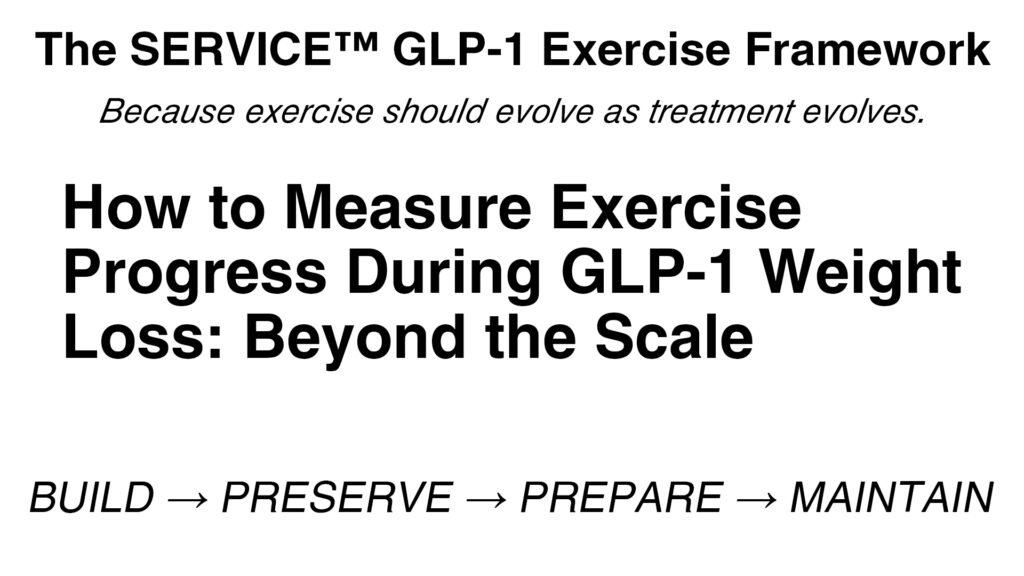
Its four phases are BUILD, PRESERVE, PREPARE, and MAINTAIN.
Each phase offers a different way to think about exercise-related needs and priorities.
BUILD: Establish an Exercise Foundation
BUILD focuses on establishing an appropriate foundation for physical activity and exercise.
Depending on your circumstances, this may involve identifying suitable activities, developing consistency, and learning how to monitor your response to exercise.
PRESERVE: Focus on Strength and Physical Function
PRESERVE emphasizes the importance of understanding muscle, strength, and physical function during weight loss.
Resistance training is an important consideration, alongside adequate nutrition and appropriate recovery.
PREPARE: Consider Changing Needs
PREPARE addresses the importance of considering exercise-related needs as circumstances change throughout treatment.
Changes in symptoms, health, fitness, and treatment plans may influence exercise considerations. Medication decisions should remain under the guidance of the prescribing healthcare professional.
MAINTAIN: Build Sustainable Exercise Habits
MAINTAIN emphasizes sustainable physical activity and long-term fitness.
The goal is to develop an approach to exercise that can adapt to changing needs rather than relying exclusively on short-term weight-loss milestones.
The SERVICE™ framework is an educational framework. Its individual phases should not be interpreted as a clinically validated protocol or a guarantee of specific outcomes.
To learn more, visit the YOUTRAINFITNESS® SERVICE™ GLP-1 Exercise & Fitness Resource Center
FREQUENTLY ASKED QUESTIONS ABOUT EXERCISE PROGRESS DURING GLP-1 WEIGHT LOSS
FREQUENTLY ASKED QUESTIONS ABOUT EXERCISE PROGRESS DURING GLP-1 WEIGHT LOSS
Is weight loss the best way to measure exercise progress while taking GLP-1 medication?
No. Weight is one measure of progress, but it does not fully describe strength, aerobic fitness, physical function, or exercise consistency.
Monitoring several relevant indicators can provide a more complete picture of your exercise journey.
How can I tell whether I’m maintaining muscle during GLP-1 weight loss?
No single observation can definitively establish whether you’re maintaining muscle mass.
Tracking resistance-training performance can provide information about strength, while body-composition assessments may offer additional information about lean mass. These measures have different limitations.
If you’re concerned about muscle loss or declining strength, discuss appropriate assessments with your healthcare professional.
Should I track my weight and strength at the same time?
You can, if both measurements are relevant to your goals.
The important distinction is that they measure different things. Weight reflects total body mass, while resistance-training performance provides information about how you’re performing specific exercises.
Neither measurement should be treated as a complete assessment of your health or fitness.
How often should I measure exercise progress?
You can record exercise participation and performance during each workout, then review patterns periodically.
A weekly review may help you evaluate consistency, while a monthly review can help you reflect on longer-term changes.
The appropriate frequency depends on what you’re measuring and whether tracking is useful rather than burdensome.
What should I do if my strength or exercise tolerance declines?
First, consider whether the change is temporary or persistent.
Sleep, nutrition, hydration, illness, recovery, and other factors can affect exercise performance.
If your strength or exercise tolerance declines persistently, or you experience unusual weakness or other concerning symptoms, contact your healthcare professional. They can help determine whether further evaluation is appropriate.
Can walking alone help preserve muscle during GLP-1 weight loss?
Walking provides valuable aerobic activity and can support cardiovascular health and physical function.
However, walking does not necessarily provide the same muscle-strengthening stimulus as resistance training.
For many adults, a combination of aerobic activity and muscle-strengthening exercise is an important consideration. Your exercise plan should reflect your health, abilities, and individual circumstances.
THE BOTTOM LINE: MEASURE MORE THAN WEIGHT
THE BOTTOM LINE: MEASURE MORE THAN WEIGHT
GLP-1-associated weight loss is only one part of your health and fitness journey.
Monitoring strength, physical function, aerobic activity, exercise consistency, and recovery can help you understand how your exercise routine is progressing.
You don’t need to track everything at once. Start with a few meaningful measures, record your observations consistently, and review them over time.
Most importantly, use the information to support sustainable exercise habits rather than to judge yourself against a number.
Your progress is about more than how much weight you lose. It’s also about how you move, how you function, and how you build an active lifestyle that supports your long-term health.
Explore More GLP-1 Exercise Resources
YOUTRAINFITNESS® is committed to providing educational resources that help people understand the relationship between GLP-1 medications, exercise, muscle preservation, and physical function.
Explore the SERVICE™ GLP-1 Exercise Framework and additional educational resources in our SERVICE™ GLP-1 Exercise & Fitness Resource Center.
RESEARCH REFERENCES
RESEARCH REFERENCES
- American Diabetes Association. Standards of Care in Diabetes—2026: Facilitating Positive Health Behaviors and Well-being to Improve Health Outcomes.
This guidance discusses physical activity, resistance exercise, and the potential benefits of muscle-strengthening activities for maintaining lean body mass in people with diabetes receiving obesity pharmacotherapy.
URL: https://doi.org/10.2337/dc26-S005
- American Diabetes Association. Pharmacologic Treatment of Obesity in Adults: Standards of Care in Overweight and Obesity.
This clinical guidance discusses assessing muscle strength and physical function, resistance training, and nutrition during obesity treatment.
URL: https://doi.org/10.2337/doci25-0008
- Centers for Disease Control and Prevention. What Counts as Physical Activity for Adults?
This resource explains general physical activity recommendations and provides examples of aerobic and muscle-strengthening activities.
URL: https://www.cdc.gov/physical-activity-basics/adding-adults/what-counts.html
Learn More About GLP-1 Exercise
For more detailed information about exercising while taking GLP-1 medications, visit our:
This resource center provides additional educational information about GLP-1 exercise, strength training, muscle preservation, progression, and related topics.
Exercise Physiology Services in Durham, NC
This GLP-1 exercise program is part of our Exercise Physiology Services in Durham, NC.
Link: Certified Exercise Physiologist in Durham NC