ABOUT THE EXERCISE PHYSIOLOGIST
ABOUT THE EXERCISE PHYSIOLOGIST

Patrick Service, M.S., ACSM-EP® is an Exercise Physiologist and founder of YOUTRAINFITNESS® in Durham, North Carolina. With 30+ years of professional experience in exercise and fitness, Patrick specializes in helping individuals safely begin and maintain exercise programs, including those using GLP-1 medications for weight management.
He developed the SERVICE™ GLP-1 Exercise Framework, an evidence-informed, four-phase conceptual framework designed to organize exercise considerations throughout different stages of GLP-1 treatment.
His approach emphasizes strength, physical function, fitness, sustainable physical activity and collaboration with healthcare professionals.
Learn more about Patrick Service
If Your Client Uses a GLP-1, Your Job Doesn’t Change
GLP-1 medications have changed the conversation around weight management—and they are changing the conversation in the fitness industry, too.
As an exercise physiologist, I’ve been thinking a lot about how we, as fitness and exercise professionals, respond to clients who use medications such as semaglutide and tirzepatide.
There is a growing narrative that people who use GLP-1 medications are somehow taking the “easy way out.”
But before we accept that narrative, I think we need to ask ourselves an important question:
What is our role as exercise professionals?
Our job isn’t to decide whether someone has earned their weight loss.
Our job is to help people move better, become stronger, improve their fitness, maintain physical function, and develop sustainable relationships with exercise.
And that doesn’t change because someone is taking a medication.
GLP-1 Medications Are Changing the Weight-Loss Conversation
GLP-1 receptor agonists and related medications have become an increasingly visible part of weight-management care.
Medications such as semaglutide and tirzepatide are being used by many people as part of a broader approach to managing obesity and improving health.
That has generated plenty of discussion in the fitness world.
Some of it is constructive.
Some of it isn’t.
I’ve heard—and seen—questions such as:
“Isn’t that just the easy way out?”
“Why don’t they just eat better and exercise?”
“Are they actually changing their lifestyle?”
“What’s the point of training if the medication is doing the work?”
These questions are worth examining.
Not because exercise professionals need to become experts in prescribing or managing medication. That’s outside our role.
But because our attitudes toward GLP-1 medications can influence the experience of the clients we work with.
What Does a Client Using a GLP-1 Still Want From Exercise?

The answer is simple: probably many of the same things any other client wants.
A person taking a GLP-1 may want to:
- Build or preserve muscle
- Increase strength
- Improve cardiovascular fitness
- Support bone health
- Improve physical function
- Become more active in daily life
- Feel more confident moving their body
- Participate in recreational activities
- Train for a specific event or goal
- Improve their relationship with exercise
None of these goals become less important because someone is taking medication.
In fact, they may become even more important.
We Need to Look Beyond the Number on the Scale
One of the challenges in weight-focused fitness culture is that the scale can become the primary measure of success.
But body weight is only one measure.
As exercise professionals, we have the opportunity to focus on outcomes that are directly connected to what we do.
Is the client able to lift more?
Can they walk farther?
Can they climb the stairs without becoming as fatigued?
Has their cardiovascular fitness improved?
Are they more physically active?
Are they stronger?
Do they have greater confidence in their physical abilities?
Are they enjoying exercise?
Are they able to participate in activities that matter to them?
These are meaningful outcomes regardless of what the scale says.
Weight loss is not the only reason exercise matters.
And exercise doesn’t become less valuable when medication is part of someone’s health-management plan.
Weight Bias Exists in the Exercise Profession
There is another conversation we need to have.
Weight bias exists within health and fitness settings.
Research has documented weight bias among exercise and nutrition professionals. A systematic review of the literature found evidence of weight bias in a substantial proportion of studies involving exercise professionals.
That doesn’t mean every exercise professional is biased.
It does mean that our profession needs to be willing to examine the assumptions we bring into our interactions with clients.
Weight bias can show up in obvious ways, but it can also be much more subtle.
It can influence the language we use.
The goals we prioritize.
The assumptions we make about motivation.
And the explanations we give for why someone has or hasn’t lost weight.
A New Layer of Stigma: How Someone Lost Weight
GLP-1 medications may be introducing another dimension to this conversation.
Instead of simply judging someone’s body size, people may begin judging how that person changed their body.
Were they able to lose weight through diet and exercise?
Did they use medication?
Did they use both?
Emerging research suggests that people can experience stigma related specifically to GLP-1-assisted weight loss.
This can create a problematic hierarchy:
Diet and exercise = earned.
Medication = taking the easy way out.
But why should we, as exercise professionals, be the people deciding whether someone’s weight loss is legitimate?
Our role isn’t to determine whether someone has demonstrated enough willpower.
Our role is to help them achieve the health, fitness and physical-function outcomes that matter to them.
It is also important to recognize the limits of the current evidence. Research specifically examining GLP-1-related stigma among fitness professionals is still emerging. The broader evidence on weight bias among exercise professionals, combined with emerging research on GLP-1-related stigma, gives us a reason to examine our assumptions—not a reason to assume that every fitness professional holds these attitudes.
Our Job Isn’t to Decide Whether Someone Has Earned Their Weight Loss
This distinction is important.
We don’t have to have an opinion about whether someone should take a particular medication in order to provide excellent exercise care.
We don’t have to endorse every medication decision.
And we don’t need to become prescribers.
We can simply recognize that medication and exercise can play different roles.
A medication may be part of someone’s medical treatment plan.
Exercise can help address strength, cardiovascular fitness, physical function, mobility, physical activity and quality of life.
Those roles don’t have to compete.
Exercise and GLP-1 Medications Don’t Have to Compete
I think this is one of the most important points for fitness professionals to consider.
The conversation doesn’t have to be:
Medication OR exercise.
It can be:
Medication AND exercise.
The two approaches can potentially complement one another within a broader health-management plan.
As exercise professionals, we can focus on the areas where we have expertise.
That might mean helping a client develop a sustainable resistance-training program.
That might also might mean improving cardiovascular fitness.
It might mean helping someone regain confidence in movement.
It can also mean finding physical activities they genuinely enjoy.
Additionally, it might mean helping someone maintain their strength and physical function while their body is changing.
Those are valuable contributions.
A Framework for Exercise During GLP-1 Treatment
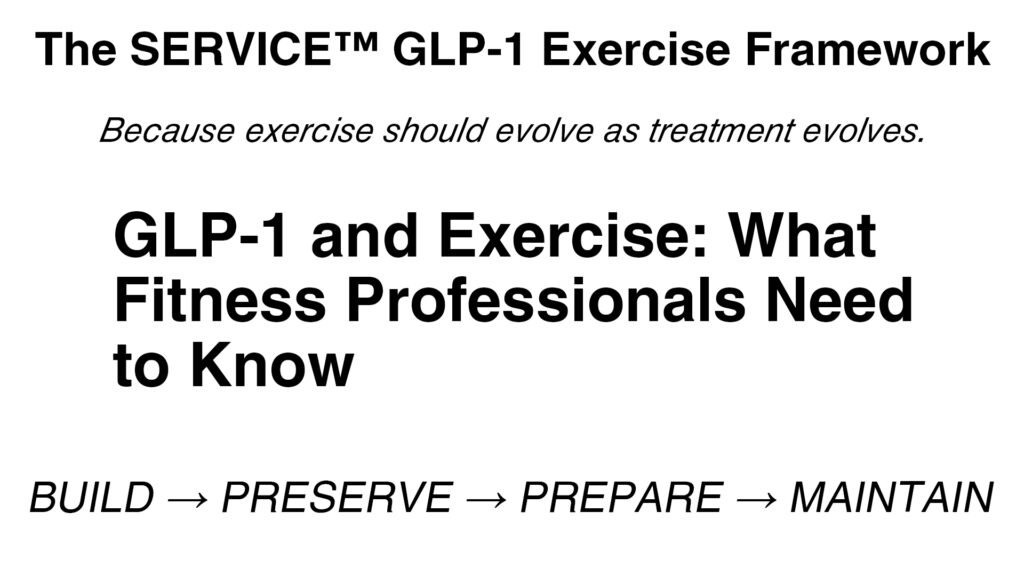
This conversation is one of the reasons I developed the SERVICE™ GLP-1 Exercise Framework.
As an exercise physiologist, I saw an opportunity to think differently about how exercise programming might evolve as a person’s GLP-1 treatment and physical capacity change.
The SERVICE™ GLP-1 Exercise Framework is an evidence-informed, four-phase conceptual framework designed to organize exercise considerations throughout different stages of GLP-1 treatment.
The four phases are:
BUILD
Establish the foundation.
For someone beginning an exercise program, the initial priority may be establishing consistency, developing exercise tolerance, learning appropriate movement patterns, and building confidence.
PRESERVE
Prioritize strength and physical capacity.
As a person progresses through active treatment and weight loss, resistance training and progressive exercise can become important components of maintaining and developing strength and physical function.
PREPARE
Prepare for treatment transition.
If treatment changes over time, exercise priorities may need to change as well. This phase focuses on developing sustainable exercise habits and maintaining the adaptations that have been developed.
MAINTAIN
Support long-term strength, fitness and physical activity.
Ultimately, the goal isn’t simply to reach a particular number on the scale.
The goal is to help people maintain the physical capabilities, fitness and exercise habits that support their long-term health and quality of life.
BUILD → PRESERVE → PREPARE → MAINTAIN
These aren’t rigid programs or four steps that every person must follow in exactly the same order.
They are changing exercise priorities.
Individual programming should still take into account a person’s treatment stage, exercise experience, physical capacity, strength, recovery, symptoms and tolerability, injury history, comorbidities, exercise adherence, goals and preferences.
And importantly, the SERVICE™ GLP-1 Exercise Framework is intended to complement medical care—not replace it.
It does not provide guidance on medication dosing, prescribing, tapering or discontinuation.
Its purpose is much simpler:
To help exercise professionals think about how exercise priorities may evolve as the person and their treatment evolve.
Learn more about the SERVICE™ GLP-1 Exercise Framework
Ask Better Questions
The questions we ask can make a significant difference in how supported a client feels.
Instead of asking:
“Are you really changing your lifestyle?”
Try:
“What are you hoping to achieve through exercise?”
Instead of:
“Are you going to stay on the medication?”
Try:
“How can we help you become stronger and more physically capable?”
Instead of:
“Wouldn’t it be better to lose the weight without medication?”
Try:
“What type of exercise do you enjoy and feel you can sustain?”
And rather than making assumptions about motivation, ask:
- “How are your energy and recovery?”
- “How is exercise feeling right now?”
- “What would make physical activity easier to maintain?”
These questions put the focus where it belongs:
On the client and their goals.
Stay Within Your Scope of Practice
Supporting someone who uses a GLP-1 doesn’t mean exercise professionals need to become experts in medication management.
We should stay within our scope of practice.
That means we can:
- Ask appropriate questions about exercise, energy, recovery and physical function
- Develop exercise programs based on the client’s needs and goals
- Monitor exercise tolerance and response
- Focus on strength, cardiovascular fitness and physical function
- Communicate with other healthcare professionals when appropriate
- Refer medication-related questions to the client’s prescribing clinician or appropriate healthcare professional
We don’t need to tell a client whether they should start, stop, or change a medication.
We can support the person without prescribing the treatment.
That distinction is important.
GLP-1s Are Changing Fitness—Let’s Make Sure We’re Ready
GLP-1 medications aren’t going away.
As exercise professionals, we have a choice about how we respond to that reality.
We can judge clients based on how they lost weight.
Or we can focus on helping them become stronger, fitter, more capable and more physically active.
We don’t have to endorse every medication decision to provide excellent, respectful exercise care to someone who uses one.
We simply need to remember what our role is.
Our clients don’t need us to decide whether they’ve “earned” their weight loss.
They need us to help them pursue the physical and health outcomes that matter to them.
So perhaps the question for the fitness profession isn’t:
“Should people be using GLP-1s?”
That’s a conversation for the individual and their healthcare team.
The question for us is:
“How can we become better exercise professionals for the people who are?”
That’s a conversation worth having.
Frequently Asked Questions
Can you exercise while taking a GLP-1 medication?
People who use GLP-1 medications may still participate in physical activity and exercise. The appropriate type, intensity and progression of exercise will depend on the individual’s health, fitness, goals, medical history and response to treatment. Medication-specific medical questions should be discussed with the appropriate healthcare professional.
Why is strength training important for people using GLP-1 medications?
Resistance training can be an important component of an overall exercise program because it helps develop and maintain strength and physical function. For an individual experiencing significant weight loss, maintaining physical capacity and lean tissue can also be an important consideration. Exercise programming should be individualized.
Should fitness professionals ask clients if they are taking a GLP-1?
Medication information can be relevant to safe and appropriate exercise programming, but fitness professionals should respect privacy and remain within their scope of practice. When medication information is relevant, appropriate communication with the client and, when necessary, their healthcare team can help support safe care.
Should exercise professionals tell clients whether they should take a GLP-1?
Exercise professionals should remain within their professional scope. Decisions about starting, changing or stopping prescription medication should be addressed with the appropriate prescribing healthcare professional.
Does using a GLP-1 mean someone doesn’t need exercise?
No. Medication and exercise address different aspects of health. Exercise can provide benefits related to strength, cardiovascular fitness, physical function, mobility, physical activity and quality of life regardless of whether someone is also using medication.
About Patrick Service, M.S., ACSM-EP
Learn more about Patrick Service
His professional credentials include:
-
ACSM Certified Exercise Physiologist (ACSM-EP)
-
ACSM Certified Personal Trainer (ACSM-CPT)
- ACSM/ACS Certified Cancer Exercise Trainer
-
NASM Corrective Exercise Specialist
-
NASM Performance Enhancement Specialist
References and Further Reading
Weight bias among exercise and nutrition professionals
https://pubmed.ncbi.nlm.nih.gov/30176183/
Perceptions of antiobesity medications among personal trainers
https://pubmed.ncbi.nlm.nih.gov/18550964/
An experimental investigation of the stigmatization of weight loss and regain from GLP-1 receptor agonist use and cessation
https://www.nature.com/articles/s41366-026-02061-y
GLP-1 receptor agonists and the emergence of treatment-related stigma
https://www.nature.com/articles/s41366-026-02200-5
Social perceptions of weight loss with GLP-1 receptor agonists
https://pubmed.ncbi.nlm.nih.gov/42181798/
Please Reach out with Questions
Phone: 919-627-8348 (919.NC.R.U.FIT)
Email: train@youtrainfitness.com
🌱 Food for Thought
"Our job isn't to decide whether someone has earned their weight loss."
TO LEARN MORE, VISIT OUR GLP-1 EXERCISE & FITNESS RESOURCE CENTER
TO LEARN MORE, VISIT OUR GLP-1 EXERCISE & FITNESS RESOURCE CENTER
THIS PROGRAM IS PART OF OUR EXERCISE PHYSIOLOGY SERVICES IN DURHAM NC
THIS PROGRAM IS PART OF OUR EXERCISE PHYSIOLOGY SERVICES IN DURHAM NC
Link: Certified Exercise Physiologist in Durham NC