
Patrick Service, M.S., ACSM-EP® is an Exercise Physiologist and founder of YOUTRAINFITNESS® in Durham, North Carolina. With 30+ years of professional experience in exercise and fitness, Patrick specializes in helping individuals safely begin and maintain exercise programs, including those using GLP-1 medications for weight management.
He developed the SERVICE™ GLP-1 Exercise Framework, an evidence-informed, four-phase conceptual framework designed to organize exercise considerations throughout different stages of GLP-1 treatment.
His approach emphasizes strength, muscle preservation, physical function, fitness, sustainable physical activity and collaboration with healthcare professionals.
Learn more about Patrick Service
Important: The SERVICE™ GLP-1 Exercise Framework is an evidence-informed conceptual framework. Research supports important components of the approach, particularly resistance exercise during weight loss, but the four-phase SERVICE™ GLP-1 Exercise Framework itself has not been established as a validated clinical intervention.
For the complete explanation of the four-phase framework itself, to include References and Evidence see the SERVICE™ GLP-1 Exercise Framework: Research Evidence and Exercise Considerations During GLP-1 Treatment article.
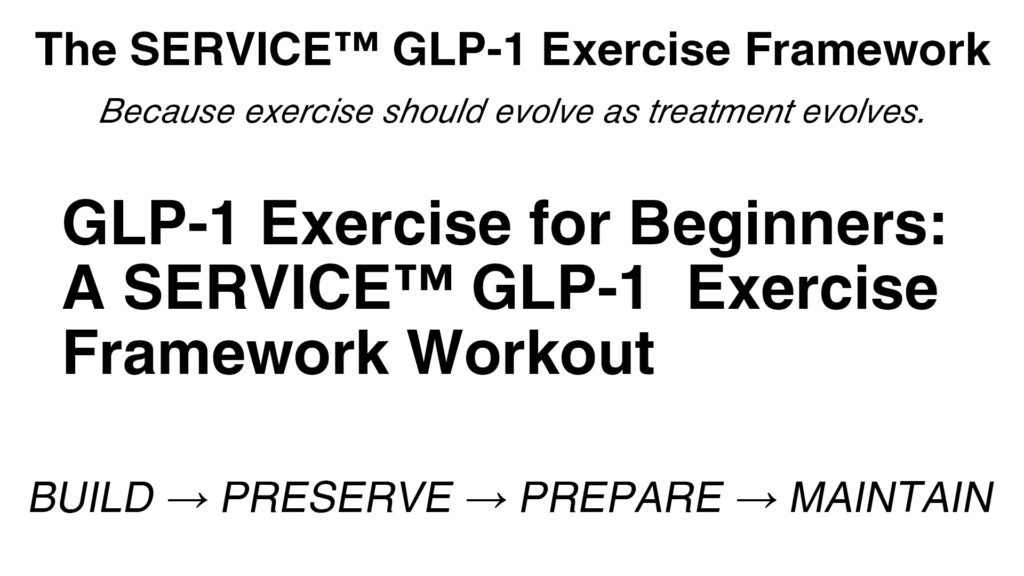
GLP-1 Exercise for Beginners: A SERVICE™ GLP-1 Exercise Framework Workout
Starting an exercise program while taking a GLP-1 medication can raise a lot of questions.
How much exercise should I do?
What exercises should I start with?
Should I lift weights?
What if I feel tired or nauseated?
When should I increase the difficulty?
The SERVICE™ GLP-1 Exercise Framework provides an evidence-informed way to approach these questions when programming exercise for beginners taking GLP-1 medications.
For a beginner, the goal is not to complete the hardest workout possible.
The goal is to build the ability to exercise consistently, develop strength and physical function, and gradually progress when the body is ready.
This article provides a general beginner exercise program based on the principles of the SERVICE™ GLP-1 Exercise Framework.
It is designed as general educational information rather than an individualized exercise prescription.
Why Exercise Matters During GLP-1 Treatment
GLP-1-based medications can produce substantial weight loss. Weight loss can involve reductions in both fat mass and lean mass.
Importantly, lean mass and skeletal muscle are not identical measurements. Lean mass can include muscle as well as water, organs, connective tissue and other tissues.
Exercise therefore has an important role beyond simply burning calories.
A well-designed exercise program can help support:
-
Muscular strength
-
Physical function
-
Fitness
-
Physical activity
-
Exercise capacity
-
Muscle and lean-tissue preservation during weight loss
The American College of Sports Medicine notes that resistance exercise can be beneficial during weight loss and may improve strength and physical function, although resistance training cannot be assumed to completely prevent lean-mass or muscle loss associated with GLP-1 medications.
A 2025 systematic review and meta-analysis also found that adding resistance exercise to dietary weight loss protected fat-free mass and improved muscular strength compared with dietary weight loss without resistance exercise.
At the same time, research specifically examining resistance exercise during semaglutide or tirzepatide treatment remains limited. Some recommendations therefore draw on broader evidence from resistance training and weight-loss populations.
That is one reason an adaptable exercise framework can be useful.
The SERVICE™ GLP-1 Exercise Framework for Beginners
The SERVICE™ GLP-1 Exercise Framework uses four phases:
BUILD
Learn how to exercise and establish the foundation.
PRESERVE
Develop and maintain strength and physical capacity during weight loss.
PREPARE
Build the capacity and habits needed for long-term exercise.
MAINTAIN
Continue strength, fitness and physical activity over the long term.
For someone who is completely new to exercise, the first priority is generally the BUILD phase.
You don’t have to start with a highly complicated workout.
You need a workout that you can perform safely, repeat consistently and gradually improve.
The Beginner GLP-1 Workout
This general program uses full-body resistance training two days per week.
Leave at least one day between resistance-training sessions when possible.
For example:
Monday — Strength
Tuesday — Walking
Wednesday — Rest or easy activity
Thursday — Strength
Friday — Walking
Saturday — Optional enjoyable activity
Sunday — Rest or easy activity
The exact schedule can be adjusted to fit your life.
Beginner Strength Workout
1. Sit-to-Stand or Chair Squat
Sets: 2
Repetitions: 8–12
Rest: 60–120 seconds
Sit toward the front of a sturdy chair.
Place your feet approximately hip-width apart.
Stand up under control.
Then slowly lower yourself back toward the chair.
If this becomes easy, progress from a higher chair to a lower chair or eventually to a bodyweight squat.
2. Hip Hinge
Sets: 2
Repetitions: 8–12
Rest: 60–120 seconds
Stand with your feet approximately hip-width apart.
Push your hips backward while keeping your torso controlled.
Return to standing by driving your hips forward.
A dowel, wall or light dumbbell can be used to help teach the movement.
The objective is to learn the hip-hinge pattern before adding substantial resistance.
3. Wall Push-Up
Sets: 2
Repetitions: 8–12
Rest: 60–120 seconds
Place your hands against a wall.
Keep your body controlled as you bend your elbows and bring your chest toward the wall.
Push yourself back to the starting position.
As strength improves, progress to a countertop or sturdy elevated surface.
Eventually, an incline push-up from a lower surface or a floor push-up may be appropriate.
4. Resistance-Band Row
Sets: 2
Repetitions: 8–12
Rest: 60–120 seconds
Anchor the resistance band securely.
Pull the band toward your torso while keeping your shoulders controlled.
Pause briefly.
Return slowly to the starting position.
The goal is to develop pulling strength while maintaining good posture and control.
5. Step-Up
Sets: 1–2
Repetitions: 8–10 per leg
Rest: 60–120 seconds
Use a stable, appropriate-height step.
Place one foot on the step.
Push through the working leg to step upward.
Lower yourself under control.
Use a railing or other stable support if needed for balance.
The step height should allow you to perform the exercise with good control.
6. Farmer Carry
Sets: 2
Duration: 20–30 seconds
Hold a light dumbbell, kettlebell or other appropriate weight in each hand.
Stand tall.
Walk slowly and under control.
Keep your shoulders relaxed and your torso upright.
If carrying weights is not appropriate, simply practice controlled walking while maintaining good posture.
How Hard Should the Workout Feel?
A beginner workout does not need to train to complete muscular failure.
A useful starting point is to choose a resistance that allows you to complete the prescribed repetitions with good technique while still feeling that you could perform several additional repetitions.
The exact effort level should be individualized.
For a new exerciser, technique and consistency are more important than lifting the heaviest possible weight.
The goal is to create an exercise stimulus that can be repeated and gradually progressed.
Beginner Cardio: Start With Walking
Walking is an accessible starting point for many beginners.
Begin with:
10–20 minutes
at an intensity that feels manageable.
If you tolerate that well, gradually increase the duration.
For example:
1st Week : 10 minutes, 3 days
2nd Week : 15 minutes, 3 days
3rd Week : 15–20 minutes, 3 days
4th Week : 20 minutes, 3–4 days
This is only an example.
Your starting point may be lower or higher depending on your current fitness.
The long-term U.S. physical-activity guideline for adults is at least 150 minutes of moderate-intensity aerobic activity per week, plus muscle-strengthening activity on at least two days per week. However, people who are currently inactive can build toward those amounts gradually.
The first objective is consistency.
What If You Feel 100%?
Some days you may feel energetic and ready to exercise.
If you feel well, can perform the exercises with good technique and are recovering appropriately, follow the GLP-1 exercise for beginners planned workout.
Don’t automatically add a large amount of exercise simply because you feel good.
Instead, use gradual progression.
For example:
Week 1
2 × 8 squats
↓
Week 2
2 × 10 squats
↓
Week 3
2 × 12 squats
↓
Week 4
Increase resistance slightly and return to approximately 2 × 8
This is an example of progressive overload.
How Progressive Overload Works
Progressive overload means gradually increasing the training challenge as your ability improves.
You can progress by:
-
Increasing repetitions.
-
Increasing resistance.
-
Adding a set.
-
Increasing walking duration.
-
Increasing walking frequency.
-
Moving to a more challenging exercise variation.
-
Improving range of motion.
-
Improving movement control.
You do not have to increase everything at once.
A small improvement is still progression.
What If You Are Fatigued?
This is an important part of exercising during GLP-1 treatment.
The workout should not be viewed as an all-or-nothing task.
If you have mild fatigue, consider reducing the training demand.
For example:
Planned
2 sets × 10 repetitions
Modified
1 set × 8–10 repetitions
Or:
Planned
20-minute walk
Modified
10-minute easy walk
Another option is to increase your rest periods.
The objective is to maintain appropriate movement when possible without forcing the planned workload on a day when your body is not responding normally.
What If You Have Nausea?
Nausea is one of the gastrointestinal adverse effects associated with GLP-1 medications.
For example, the FDA prescribing information for semaglutide products identifies nausea, vomiting, diarrhea, abdominal pain and constipation among commonly reported adverse reactions. The prescribing information also warns about volume depletion associated with gastrointestinal adverse reactions.
Tirzepatide prescribing information similarly identifies gastrointestinal adverse reactions, including nausea, vomiting and diarrhea, which can contribute to dehydration.
If you have mild symptoms and otherwise feel well, you may need to reduce the exercise intensity or duration.
If you are experiencing significant nausea, vomiting, dizziness, dehydration, unusual weakness or other concerning symptoms, do not treat exercise as something you need to push through.
Postpone exercise as appropriate and seek appropriate medical guidance when warranted.
The SERVICE™ Dial-Back Approach
A simple way to think about a GLP-1 exercise for beginners workout is:
🟢 Green — Feeling well
Do the planned workout.
Use your normal resistance, repetitions and walking duration.
If the workout is becoming easy and you are recovering appropriately, begin gradual progression.
🟡 Yellow — Not Feeling 100%
Modify the workout.
Consider:
-
Less resistance.
-
Fewer repetitions.
-
Fewer sets.
-
More rest.
-
Easier exercise variations.
-
Shorter walking sessions.
The objective is to adapt the workout to your current exercise tolerance.
🔴 Red — Significant Symptoms
Don’t push through significant symptoms.
Examples include:
-
Significant or worsening nausea.
-
Vomiting.
-
Dizziness.
-
Signs of dehydration.
-
Unusual weakness.
-
Chest pain.
-
Significant shortness of breath.
-
Fainting or near-fainting.
-
Other symptoms that concern you.
Depending on the situation, exercise may need to be stopped or postponed and medical evaluation may be appropriate.
How Do You Know When You’re Ready to Progress?
Don’t use medication side effects alone to determine when you’re ready for progressive overload.
Someone can have minimal GLP-1 side effects and still need a beginner program.
Instead, look at the whole picture.
You may be ready to progress when you can:
-
Complete your workouts consistently.
-
Perform the exercises with good technique.
-
Recover appropriately.
-
Complete the upper end of your repetition range.
-
Handle your current resistance comfortably.
-
Maintain control throughout the movement.
-
Tolerate your cardio program.
-
Progress without significant pain or concerning symptoms.
At that point, a more structured progressive-overload program may be appropriate.
Should You Exercise at Home or in a Gym?
Both options can work for a GLP-1 exercise for beginners Program.
At Home
A beginner can perform many useful exercises with:
-
A chair.
-
Resistance bands.
-
Dumbbells.
-
Bodyweight.
-
A step.
-
Walking.
Home exercise can reduce barriers and make consistency easier.
At the Gym
A gym provides additional options such as:
-
Resistance machines.
-
Cable systems.
-
Dumbbells.
-
Barbells.
-
Cardio machines.
The additional equipment can make progressive overload easier to implement.
The SERVICE™ GLP-1 Exercise Framework can be applied in either environment.
What About Semaglutide?
People taking semaglutide may use the same fundamental exercise principles:
Strength training + aerobic activity + gradual progression + appropriate recovery.
The specific workout should depend on the person’s current fitness, exercise experience, physical limitations, goals and response to treatment.
Semaglutide does not automatically mean that someone needs a special type of exercise.
However, medication-related symptoms may affect how much exercise a person can comfortably tolerate on a particular day.
What About Tirzepatide?
The same general principle applies to people taking tirzepatide.
Tirzepatide-associated weight loss can include reductions in fat mass and lean mass. Research and expert guidance therefore support considering resistance exercise and physical activity as part of comprehensive weight-management care.
Direct evidence specifically testing different resistance-training programs during tirzepatide treatment remains limited, so exercise recommendations should not overstate what the current research proves.
Can Exercise Help Preserve Muscle During GLP-1 Weight Loss?
Resistance training can help support muscle strength and fat-free mass during weight loss.
However, it is important to use precise language.
Exercise cannot guarantee that all muscle will be preserved.
Current evidence supports resistance training as an important component of weight-loss programs, but the precise effects of resistance training alongside individual GLP-1 medications require further research.
This is why the SERVICE™ GLP-1 Exercise Framework emphasizes strength and physical function, not simply trying to prevent every change in body composition.
A Simple Beginner Weekly Schedule
Here is one way to organize the program:
| Day | Activity |
|---|---|
| Monday | Full-body strength workout |
| Tuesday | 10–20 minute walk |
| Wednesday | Rest or easy activity |
| Thursday | Full-body strength workout |
| Friday | 10–20 minute walk |
| Saturday | Optional enjoyable activity |
| Sunday | Rest or easy activity |
As your fitness improves, you can gradually increase your weekly activity.
The schedule should remain flexible.
If fatigue or medication-related symptoms affect your exercise tolerance, modify the plan rather than forcing the original schedule.
What Should a Beginner Focus on First?
The first goal should be consistency.
Then focus on:
Technique
↓
Exercise tolerance
↓
Repetition quality
↓
Gradual progression
↓
Strength and physical function
This sequence fits the BUILD-to-PRESERVE progression of the SERVICE™ GLP-1 Exercise Framework.
You do not need to begin with advanced training.
You need to establish a foundation that can eventually support more advanced training.
When Should You Get an Individualized Exercise Program?
A general beginner program is not appropriate for every person.
Individualized exercise programming may be especially useful if you have:
-
A significant orthopedic limitation.
-
Previous injuries.
-
Balance problems.
-
Neurological limitations.
-
Cardiovascular limitations.
-
Significant weakness.
-
Mobility restrictions.
-
A complex medical history.
-
Significant exercise-related symptoms.
-
A specific performance or rehabilitation goal.
In these situations, an exercise professional can modify exercise selection, resistance, volume, frequency and progression according to your individual circumstances.
How the SERVICE™ GLP-1 Exercise Framework Can Be Individualized
The framework provides a general structure.
An individualized exercise physiology program can then determine:
-
Which exercises are appropriate.
-
Which exercises should be modified.
-
How much resistance to use.
-
How much volume to perform.
-
How frequently to train.
-
How to progress.
-
When to reduce the workload.
-
Which exercises may be inappropriate because of a specific limitation.
This distinction is important.
The framework provides the structure.
Individualized exercise physiology provides the personalization.
The Beginner Takeaway
If you are taking a GLP-1 medication and are new to exercise, you do not have to start with an advanced workout.
Start with manageable resistance training.
Add walking or another enjoyable form of aerobic activity.
Learn the movements.
Build consistency.
Pay attention to recovery and exercise tolerance.
When you feel well and are ready, gradually increase the challenge.
When fatigue or other symptoms reduce your exercise tolerance, modify the workout.
And when symptoms are significant or your individual circumstances require specialized programming, seek appropriate professional guidance.
That is the practical philosophy behind the SERVICE™ GLP-1 Exercise Framework:
BUILD the foundation.
PRESERVE strength and physical capacity.
PREPARE for long-term exercise.
MAINTAIN the gains and habits you have developed.
Exercise during GLP-1 treatment does not have to be an all-or-nothing proposition.
The goal is to develop a sustainable approach that can adapt as the individual changes.
Looking for Personalized GLP-1 Exercise Guidance?
If you’re looking for individualized GLP-1 exercise programming and guidance from an ACSM-certified exercise physiologist in Durham, NC, learn more about our GLP-1 Exercise for Beginners in Durham, NC.
Frequently Asked Questions
What is the best exercise for a beginner taking a GLP-1?
A combination of resistance training and aerobic activity is a useful general starting point. For many beginners, simple full-body resistance exercises combined with walking can provide an accessible foundation.
How often should a beginner exercise on a GLP-1?
A reasonable general starting point is full-body resistance training twice per week, combined with manageable aerobic activity such as walking on additional days.
Should I lift weights while taking semaglutide?
Resistance training can be an important component of exercise during weight loss. The appropriate exercises and resistance depend on the individual’s fitness and circumstances.
Should I lift weights while taking tirzepatide?
Resistance training can support strength and physical function during weight loss. A beginner should start with manageable resistance and progress gradually.
Can I do this workout at home?
Yes. The exercises can be adapted for home use with bodyweight, resistance bands, dumbbells and simple equipment.
Do I need a gym?
No. A gym is not required to begin exercising.
What if I feel tired during my workout?
Reduce the exercise demand. You can use lighter resistance, fewer sets, fewer repetitions, more rest or a shorter cardio session.
What if I feel nauseated?
If symptoms are mild, reducing exercise intensity or duration may be appropriate. Significant nausea, vomiting, dizziness or dehydration should not be ignored or pushed through.
Should I exercise if I am vomiting?
Exercise should generally be postponed when vomiting or significant gastrointestinal symptoms are present. Because vomiting can contribute to dehydration, appropriate medical guidance may be warranted depending on the circumstances.
When should I start progressive overload?
Progressive overload becomes appropriate when you have established exercise consistency, can perform the movements with good technique, recover appropriately and can handle the current workload.
Does having no GLP-1 side effects mean I should start progressive overload?
No. Exercise experience and readiness are also important.
Can exercise prevent muscle loss from GLP-1 medications?
Exercise cannot guarantee complete muscle preservation. Resistance training is an important strategy for supporting strength and lean tissue during weight loss.
How long should a beginner workout last?
The resistance portion may initially be relatively short. A complete beginner can start with a manageable session and gradually increase duration as exercise tolerance improves.
Should I exercise every day?
You do not need to perform resistance training every day. Beginners can build a strong foundation with two full-body resistance sessions per week and additional manageable physical activity.
What if I miss a workout?
Simply resume your normal schedule when you are ready. Missing one workout does not mean you need to compensate with an excessively difficult workout.
Is walking enough?
Walking provides valuable aerobic activity, but resistance training offers a different stimulus for maintaining and developing muscular strength. A comprehensive program can include both.
Can the SERVICE™ GLP-1 Exercise Framework be customized?
Yes. The framework can provide a general structure, while individualized exercise physiology programming can adapt exercises, resistance, volume and progression to a person’s specific circumstances.
References
1. Optimizing GLP-1 therapies for obesity and diabetes management — PubMed
2. Navigating the Impact of New Weight Loss Medications — American College of Sports Medicine
Navigating the Impact of New Weight Loss Medications
Webinar Q&A | Effects of Aerobic & Resistance Training on Food Intake
5. Nutritional priorities to support GLP-1 therapy for obesity — PubMed
6. Semaglutide (Ozempic) Prescribing Information — FDA
7. Tirzepatide (Mounjaro) Prescribing Information — FDA
SERVICE™ GLP-1 Exercise Framework | Research, Evidence & Exercise Considerations During GLP-1 Treatment
9. Patrick Service, M.S., ACSM-EP — Professional Vita — YOUTRAINFITNESS®
Service M.S., Patrick W. | Vita
The SERVICE™ GLP-1 Exercise Framework: A 4-Phase Exercise Plan for Weight Loss, Muscle Preservation, and Building Healthy Habits
Disclaimer
This article provides general educational information about exercise during GLP-1 treatment. It is not individualized medical advice, diagnosis or a substitute for care from a qualified healthcare professional.
Exercise programs should be adapted to the individual’s health status, exercise experience, physical abilities, goals and response to treatment. People with medical conditions, significant symptoms or exercise limitations should obtain appropriate professional guidance before beginning or changing an exercise program.
Learn More About GLP-1 Exercise
For more detailed information about exercising while taking GLP-1 medications, visit our:
This resource center provides additional educational information about GLP-1 exercise, strength training, muscle preservation, progression, and related topics.
Exercise Physiology Services in Durham, NC
This GLP-1 exercise program is part of our Exercise Physiology Services in Durham, NC.
Link: Certified Exercise Physiologist in Durham NC