ABOUT THE EXERCISE PHYSIOLOGIST
ABOUT THE EXERCISE PHYSIOLOGIST

Patrick Service, M.S., ACSM-EP® is an Exercise Physiologist and founder of YOUTRAINFITNESS® in Durham, North Carolina. With 30+ years of professional experience in exercise and fitness, Patrick specializes in helping individuals safely begin and maintain exercise programs, including those using GLP-1 medications for weight management.
He developed the SERVICE™ GLP-1 Exercise Framework, an evidence-informed, four-phase conceptual framework designed to organize exercise considerations throughout different stages of GLP-1 treatment.
His approach emphasizes strength, muscle preservation, physical function, fitness, sustainable physical activity and collaboration with healthcare professionals.
Learn more about Patrick Service
MUSCLE PRESERVATION DURING GLP-1 WEIGHT LOSS: WHAT YOU NEED TO KNOW
MUSCLE PRESERVATION DURING GLP-1 WEIGHT LOSS: WHAT YOU NEED TO KNOW
When you’re taking a GLP-1 medication for weight management, you may focus on how much weight you’re losing. But another important question deserves attention: How can you support your muscle strength and physical function while losing weight?
Medications such as semaglutide and tirzepatide can help people with appropriate medical indications achieve substantial weight loss. However, weight reduction can involve changes in both fat mass and lean mass.
That matters because maintaining muscle strength and physical function can help support everyday activities, mobility, and independence.
Research and clinical guidance suggest that resistance training and adequate nutritional intake deserve particular attention during weight management with these medications. However, individual outcomes vary, and neither exercise nor nutrition can guarantee that muscle loss will be prevented.
If you’re taking a GLP-1 medication and want to understand the role of exercise in muscle preservation, this article explains what the research tells us, which measures are useful to monitor, and how to approach your fitness journey.
WHY MUSCLE PRESERVATION MATTERS DURING GLP-1 WEIGHT LOSS
WHY MUSCLE PRESERVATION MATTERS DURING GLP-1 WEIGHT LOSS
Muscles do much more than help you lift weights.
Skeletal muscle contributes to movement, balance, posture, and the ability to perform everyday activities. It also plays important roles in glucose metabolism and overall physical function.
During weight loss, your body may lose both fat mass and lean mass. The proportions vary depending on factors such as the amount and rate of weight loss, baseline body composition, nutrition, physical activity, age, and other individual circumstances.
For people taking GLP-1 medications, this raises an important question: How can weight management support improvements in health while also considering muscle strength and function?
Weight loss is not the only measure of progress
Imagine two people who experience similar reductions in body weight.
One person participates in an appropriate resistance-training program, maintains adequate nutritional intake, and gradually improves their exercise performance.
The other person experiences difficulty eating enough, becomes less physically active, and notices declining strength.
Their weight changes might be similar, but their exercise experiences and physical capabilities could be different.
This example illustrates why weight alone cannot fully describe someone’s physical health or fitness.
The American Diabetes Association recommends that clinicians counsel people receiving obesity pharmacotherapy about adequate protein intake and muscle-strengthening activity to help minimize muscle loss during weight reduction. It also discusses monitoring muscle strength and physical function when appropriate.
The goal is not simply to lose weight. It is to support overall health, strength, and physical function throughout the process.
UNDERSTANDING LEAN MASS, MUSCLE MASS, AND MUSCLE STRENGTH
UNDERSTANDING LEAN MASS, MUSCLE MASS, AND MUSCLE STRENGTH
Before exploring exercise strategies, it helps to understand three related but different concepts.
What is lean mass?
Lean mass generally refers to body mass other than fat mass, although the precise definition depends on the measurement method.
It includes skeletal muscle but also encompasses other nonfat tissues and body components.
Consequently, a reduction in measured lean mass does not necessarily mean that the same amount of skeletal muscle has been lost.
Changes in hydration and the method used to assess body composition can also affect measurements.
What is skeletal muscle mass?
Skeletal muscle is the muscle tissue primarily responsible for voluntary movement.
It helps you walk, climb stairs, lift objects, maintain posture, and perform resistance exercises.
Skeletal muscle is one component of lean mass, but the terms are not interchangeable.
What is muscle strength?
Muscle strength describes the ability to produce force.
It can be assessed in several ways, including standardized strength tests and performance during resistance exercises.
Muscle strength and muscle mass are related, but they are not identical. Someone’s strength can change without an equivalent change in measured muscle mass.
This distinction is important when interpreting research and monitoring your own progress.
For example, performing more repetitions with a familiar resistance may indicate improved exercise performance. However, it does not independently establish that muscle mass has increased or been maintained.
Why these distinctions matter
Researchers and healthcare professionals may use different methods to assess body composition, muscle strength, and physical function.
These measurements answer different questions.
When evaluating your progress during GLP-1 weight loss, it can be helpful to consider several indicators rather than relying on one measurement.
For a deeper discussion, see the companion article: How to Measure Exercise Progress During GLP-1 Weight Loss: Beyond the Scale.
WHAT DOES RESEARCH TELL US ABOUT GLP-1 MEDICATIONS AND MUSCLE?
WHAT DOES RESEARCH TELL US ABOUT GLP-1 MEDICATIONS AND MUSCLE?
Research on GLP-1-based medications and body composition has raised important questions about changes in lean mass during substantial weight loss.
In clinical trials of medications such as semaglutide and tirzepatide, reductions in body weight have included reductions in measured lean mass as well as fat mass.
However, the proportion of weight lost as lean mass varies across studies and individuals. Lean mass measurements should not be interpreted as direct measurements of skeletal muscle alone.
Does everyone taking a GLP-1 medication lose muscle?
No. It would be inaccurate to assume that every person taking a GLP-1 medication will experience the same changes in muscle mass, strength, or function.
Outcomes can be influenced by many factors, including:
- The amount and rate of weight loss.
- Baseline muscle mass and physical function.
- Age and health status.
- Overall energy and nutritional intake.
- Protein intake and other aspects of nutrition.
- Participation in resistance training and other physical activity.
- The methods used to assess body composition and muscle function.
Some people may experience meaningful improvements in mobility and physical function as their weight decreases, even when measurements indicate a reduction in lean mass.
Others, particularly those who already have limitations in strength or physical function, may benefit from closer monitoring and individualized support.
What does this mean for you?
It means that concerns about muscle preservation should be addressed thoughtfully rather than through fear.
You do not need to assume that muscle loss is inevitable. You also should not assume that losing weight automatically means your strength and physical function are improving.
Instead, consider how nutrition, resistance training, recovery, and appropriate monitoring can fit into your overall healthcare plan.
A 2024 review published in Diabetes Care discusses the potential role of resistance exercise alongside incretin-based weight-loss medications and highlights the need for further research on body composition and muscle preservation. Diabetes Journals
Full reference URL:
https://doi.org/10.2337/dci24-0018
RESISTANCE TRAINING IS AN IMPORTANT PART OF MUSCLE PRESERVATION
RESISTANCE TRAINING IS AN IMPORTANT PART OF MUSCLE PRESERVATION
If muscle strength and physical function are priorities during GLP-1 weight loss, resistance training deserves particular attention.
Resistance training involves working your muscles against resistance. Examples include using dumbbells, resistance bands, weight machines, or appropriately selected bodyweight exercises.
It can help improve strength and physical function. It is also an important component of exercise programs intended to support lean mass during weight reduction.
The American Diabetes Association recommends muscle-strengthening activity as part of comprehensive care for people receiving obesity pharmacotherapy. Research reviews also support considering resistance training during incretin-based weight-loss treatment.
How does resistance training work?
When you perform a resistance exercise, your muscles work against an external load or your body weight.
With appropriate programming and recovery, repeated training can stimulate adaptations that improve strength and other aspects of physical performance.
The appropriate exercise selection, resistance, frequency, and training volume depend on your individual circumstances.
For someone new to exercise, this may mean learning a few basic movements with light resistance before progressing.
For someone who already exercises regularly, it may mean reviewing their current program to determine whether it adequately addresses their strength goals.
What types of resistance exercises can you perform?
Depending on your abilities, preferences, and health status, options may include:
- Sit-to-stand exercises: Practicing standing up from a stable chair.
- Wall push-ups: Using a wall to perform a modified pushing movement.
- Resistance-band exercises: Using bands to provide adjustable resistance.
- Dumbbell exercises: Performing appropriate movements with free weights.
- Weight-machine exercises: Using gym equipment with suitable instruction.
- Supervised strength training: Working with a qualified professional to develop an individualized program.
These are examples rather than a prescribed routine. Some exercises may be unsuitable for people with particular injuries, mobility limitations, or medical conditions.
If you’re new to resistance training, a qualified exercise professional can help you select appropriate movements and learn proper technique.
How often should you perform resistance training?
General physical activity guidelines recommend muscle-strengthening activities on at least two days per week for adults.
However, that recommendation is not a requirement to begin with two full workouts immediately.
Your starting frequency should reflect your current fitness, recovery, medical circumstances, and exercise experience.
Some people may benefit from supervised sessions or a modified program before progressing toward a more comprehensive routine.
The goal is to develop an approach that challenges your muscles appropriately while allowing adequate recovery.
Resistance training is not about lifting the heaviest possible weight. It is about providing an appropriate, repeatable stimulus that supports your individual goals.
ADEQUATE NUTRITION MATTERS TOO
ADEQUATE NUTRITION MATTERS TOO
Exercise is an important part of the muscle-preservation conversation, but it is not the only consideration.
Your body also needs adequate energy, protein, vitamins, minerals, and other nutrients to support normal physiological function and recovery.
Some people taking GLP-1 medications experience reduced appetite or gastrointestinal symptoms that make it difficult to eat enough.
This can create challenges when trying to maintain nutritional adequacy during weight loss.
Why is protein important?
Protein supplies amino acids that the body uses for many functions, including maintaining and repairing tissues.
Muscle tissue is continually undergoing processes of breakdown and repair. Adequate protein intake is one factor that supports these processes.
The American Diabetes Association recommends attention to adequate protein intake during obesity pharmacotherapy, alongside muscle-strengthening activity. A joint advisory from several nutrition and obesity organizations also emphasizes individualized nutrition planning during GLP-1 treatment. DOI+1
However, there is no single protein target that is appropriate for everyone.
Your needs may depend on factors such as age, body size, nutritional status, activity level, kidney function, and other medical circumstances.
What if your appetite has decreased?
If you’re finding it difficult to eat enough, consider discussing your nutritional intake with your healthcare professional.
A registered dietitian familiar with obesity treatment can help you evaluate your needs and identify practical ways to improve nutritional adequacy.
Depending on your circumstances, that might involve reviewing meal patterns, identifying foods you tolerate well, or discussing whether a nutritional supplement is appropriate.
Do not assume that consuming more protein alone will prevent muscle loss.
Nutrition and exercise serve complementary roles, and simply increasing protein intake does not replace an appropriate resistance-training program.
Do you need protein supplements?
Not necessarily.
Some people can meet their protein needs through food, while others may benefit from additional support.
Whether a supplement is appropriate depends on your overall diet, nutritional requirements, medical history, preferences, and ability to tolerate different foods.
Consult a qualified healthcare professional or registered dietitian before making substantial dietary changes, particularly if you have kidney disease or another condition that affects protein requirements.
The goal is adequate, individualized nutrition—not consuming as much protein as possible.
INCLUDE AEROBIC ACTIVITY IN YOUR EXERCISE PLAN
INCLUDE AEROBIC ACTIVITY IN YOUR EXERCISE PLAN
Although resistance training deserves particular attention when discussing muscle preservation, aerobic activity remains an important part of overall health and fitness.
Walking, cycling, swimming, and other aerobic activities can support cardiovascular health and cardiorespiratory fitness.
They can also help you establish regular movement habits and improve your ability to participate in everyday activities.
Does walking preserve muscle?
Walking engages muscles and provides valuable physical activity, but it does not necessarily provide the same muscle-strengthening stimulus as progressive resistance training.
If your goal includes supporting muscle strength during weight loss, consider how both aerobic and resistance exercise can fit into your routine.
The appropriate combination depends on your current fitness, medical circumstances, and preferences.
How much aerobic activity should you aim for?
General guidelines recommend that adults work toward at least 150 minutes of moderate-intensity aerobic activity per week, alongside muscle-strengthening activities on at least two days per week.
These are general public health recommendations, not a personalized prescription for everyone taking GLP-1 medication.
If you are currently inactive, you may need to begin with shorter periods of activity and build gradually.
For some people, five to 10 minutes of comfortable walking may be a suitable starting point. Others may require modified activities or professional guidance.
Full reference URL:
https://www.cdc.gov/physical-activity-basics/adding-adults/what-counts.html
Why combine different types of exercise?
Resistance training and aerobic activity serve complementary purposes.
Resistance training provides a direct stimulus for strength development, while aerobic activity supports cardiovascular fitness and other health outcomes.
A well-rounded program can incorporate both while allowing sufficient recovery and adapting to changes in your symptoms, fitness, and daily routine.
You do not need to achieve every exercise target immediately.
Start at an appropriate level and progress according to your individual needs.
MONITOR STRENGTH AND PHYSICAL FUNCTION, NOT JUST BODY COMPOSITION
MONITOR STRENGTH AND PHYSICAL FUNCTION, NOT JUST BODY COMPOSITION
If you want to understand whether your exercise routine is helping, consider monitoring how you perform physical activities.
Body-composition measurements may provide useful information, but they cannot fully describe strength or everyday function.
What can you monitor yourself?
Depending on your exercise experience, consider recording:
- The resistance and repetitions used during familiar exercises.
- Your ability to perform movements with appropriate technique.
- How comfortably you complete familiar walking activities.
- Whether everyday activities are becoming easier or more difficult.
- Your consistency with resistance training and aerobic activity.
- Changes in fatigue or exercise tolerance.
For example, you might notice that standing up from a chair has become easier or that you can complete a familiar resistance exercise with improved control.
These observations can help you recognize patterns, although they do not independently establish changes in muscle mass.
What assessments might a professional use?
Depending on your circumstances, a healthcare or exercise professional may use standardized assessments to evaluate strength and physical function.
Examples include:
- Handgrip strength testing.
- Chair-to-stand testing.
- Walking tests.
- Other appropriate measures of physical performance.
The American Diabetes Association identifies these types of assessments as potential ways to monitor muscle strength and function during obesity treatment. DOI
Not every assessment is appropriate for every person, and results should be interpreted in context.
If you notice persistent weakness, declining exercise performance, or increasing difficulty with everyday activities, discuss these changes with your healthcare professional.
What about body-composition testing?
Methods such as dual-energy X-ray absorptiometry and bioelectrical impedance analysis can provide estimates of body composition.
However, they have different limitations, and neither should automatically be interpreted as a direct measurement of all aspects of skeletal muscle health.
Hydration, measurement conditions, and other factors may influence results.
If body composition is a concern, ask your healthcare professional whether testing would be useful and how the results should be interpreted.
The most informative approach considers body composition alongside strength, physical function, and overall health.
RECOGNIZE WHEN SYMPTOMS MAY AFFECT YOUR EXERCISE ROUTINE
RECOGNIZE WHEN SYMPTOMS MAY AFFECT YOUR EXERCISE ROUTINE
People taking GLP-1 medications can experience different side effects and changes in appetite.
Some experience nausea, vomiting, diarrhea, constipation, or fatigue. These symptoms can affect their ability to eat, drink, recover, and participate in physical activity.
If symptoms interfere with your routine, adjusting your exercise plan may be appropriate.
What if you feel unusually tired?
Mild tiredness may sometimes make a shorter or easier session more appropriate.
However, persistent or unusual fatigue should not automatically be attributed to your medication.
If fatigue interferes with daily activities or continues despite appropriate rest, contact your healthcare professional.
What if you’re having difficulty eating enough?
Inadequate nutritional intake can complicate efforts to maintain strength and physical function during weight loss.
If nausea, reduced appetite, vomiting, or other symptoms make it difficult to meet your nutritional needs, discuss this with your healthcare professional.
A registered dietitian may also help you evaluate your intake and identify appropriate strategies.
Should you train through symptoms?
You should not force yourself through significant symptoms simply to complete a planned workout.
Stop exercising if you experience concerning symptoms. Severe abdominal pain, chest pain, fainting, or difficulty breathing warrant urgent medical assessment.
Persistent vomiting or an inability to keep fluids down also requires prompt medical advice.
Your exercise plan should support your health rather than encourage you to ignore symptoms.
COMMON MYTHS ABOUT MUSCLE PRESERVATION DURING GLP-1 WEIGHT LOSS
COMMON MYTHS ABOUT MUSCLE PRESERVATION DURING GLP-1 WEIGHT LOSS
Understanding the evidence can help you make more informed decisions about your exercise routine.
Myth 1: Everyone taking GLP-1 medication will lose significant muscle
Reality: Changes in body composition vary between individuals. Weight loss can involve reductions in lean mass, but the amount varies, and lean mass is not identical to skeletal muscle.
Myth 2: Losing lean mass always means losing the same amount of muscle
Reality: Lean mass includes components other than skeletal muscle. A change in lean mass does not automatically indicate an equivalent change in muscle tissue.
Myth 3: Protein alone will prevent muscle loss
Reality: Adequate protein is important, but it does not replace resistance training or comprehensive nutritional care.
Myth 4: Walking is all you need to maintain muscle strength
Reality: Walking provides important health benefits, but it does not necessarily provide the same strengthening stimulus as resistance training.
Myth 5: If your weight is decreasing, your fitness must be improving
Reality: Weight changes do not fully describe strength, aerobic fitness, or physical function. Monitoring multiple indicators can provide a more complete picture.
Myth 6: You need an expensive gym membership to start strength training
Reality: Depending on your abilities and health, resistance training may be possible using bands, appropriate bodyweight exercises, or simple equipment. The important consideration is selecting a suitable program and performing it safely.
HOW THE SERVICE GLP-1 EXERCISE FRAMEWORK FITS INTO MUSCLE PRESERVATION
HOW THE SERVICE GLP-1 EXERCISE FRAMEWORK FITS INTO MUSCLE PRESERVATION
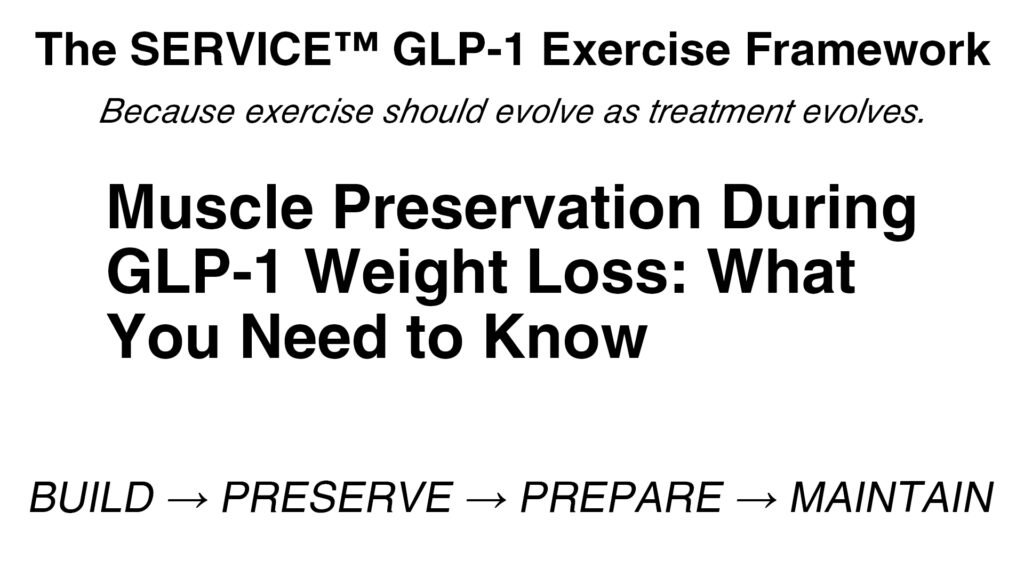
At YOUTRAINFITNESS®, the SERVICE™ GLP-1 Exercise Framework provides an educational structure for understanding exercise throughout the GLP-1 treatment journey.
Its four phases—BUILD, PRESERVE, PREPARE, and MAINTAIN—offer a way to organize learning around exercise-related priorities.
BUILD: Establish Your Exercise Foundation
BUILD focuses on developing an appropriate foundation for physical activity.
This can include identifying suitable activities, learning basic exercise principles, and establishing realistic goals based on your current abilities.
PRESERVE: Understand Muscle and Strength
PRESERVE focuses on muscle, strength, and physical function during weight loss.
This phase connects naturally with resistance training, adequate nutrition, recovery, and monitoring relevant changes over time.
The objective is to help people understand these considerations, not to guarantee that muscle loss can be eliminated.
PREPARE: Understand Changing Needs
PREPARE emphasizes the importance of recognizing that exercise-related needs may change throughout treatment.
Changes in symptoms, physical abilities, health, and treatment plans may influence exercise considerations.
Medication decisions should remain under the guidance of the prescribing healthcare professional.
MAINTAIN: Support Long-Term Fitness
MAINTAIN focuses on sustainable physical activity and long-term fitness habits.
Rather than concentrating exclusively on short-term weight changes, this phase encourages attention to strength, physical function, and an exercise routine that can adapt as circumstances change.
The SERVICE™ framework is an educational model, not a clinically validated treatment protocol or a guarantee of specific outcomes.
To learn more, visit the YOUTRAINFITNESS® SERVICE™ GLP-1 Exercise & Fitness Resource Center.
FREQUENTLY ASKED QUESTIONS ABOUT MUSCLE PRESERVATION DURING GLP-1 WEIGHT LOSS
FREQUENTLY ASKED QUESTIONS ABOUT MUSCLE PRESERVATION DURING GLP-1 WEIGHT LOSS
Can you prevent muscle loss while taking a GLP-1 medication?
No exercise or nutrition strategy can guarantee that muscle loss will be prevented during weight reduction.
However, resistance training and adequate nutritional intake are important considerations for supporting muscle strength and helping preserve lean mass. Your approach should be individualized to your health, nutritional needs, and physical abilities.
Does semaglutide cause muscle loss?
Semaglutide can produce substantial weight loss, and studies have reported reductions in measured lean mass alongside reductions in fat mass.
However, lean mass is not the same as skeletal muscle mass. Individual outcomes vary, and a reduction in lean mass does not automatically mean that muscle strength or physical function has deteriorated.
If you’re concerned about changes in strength or body composition, discuss appropriate monitoring with your healthcare professional.
Does tirzepatide cause muscle loss?
Tirzepatide-associated weight loss can include reductions in both fat mass and lean mass.
The amount and significance of these changes vary among individuals. Research continues to examine how exercise, nutrition, and other factors may influence body composition and physical function during treatment.
What is the best exercise for preserving muscle during GLP-1 weight loss?
Resistance training is an important consideration because it provides a direct stimulus for improving or maintaining muscle strength.
Examples include appropriately selected exercises using resistance bands, dumbbells, weight machines, or body weight.
Aerobic activity is also valuable for overall health. Many people can benefit from a combination of resistance and aerobic exercise, tailored to their abilities and medical circumstances.
How much protein do I need while taking a GLP-1 medication?
Protein requirements vary according to factors such as age, body size, activity level, nutritional status, and medical history.
There is no single protein target that is appropriate for everyone taking a GLP-1 medication.
A registered dietitian or other qualified healthcare professional can help you determine an appropriate intake, particularly if you have kidney disease or other conditions that affect your nutritional requirements.
How can I tell if I’m losing muscle?
You generally cannot determine muscle loss from body weight alone.
Changes in strength, physical function, and exercise performance can provide useful information, while body-composition assessments may offer additional evidence.
However, these measures have different limitations. Persistent weakness or declining physical function should be discussed with your healthcare professional.
Can beginners start resistance training during GLP-1 treatment?
Many beginners can incorporate resistance training into their exercise routine, but the appropriate starting point depends on their health, abilities, and symptoms.
Start with suitable exercises and manageable resistance. Consider working with a qualified exercise professional if you’re unfamiliar with strength training or have physical limitations.
Should I stop taking my GLP-1 medication if I’m concerned about muscle loss?
Do not stop or change your medication without discussing it with your prescribing healthcare professional.
If you’re concerned about muscle strength, nutritional intake, or physical function, discuss these concerns with your healthcare team. They can help you evaluate your situation and determine whether adjustments to your overall care plan are appropriate.
THE BOTTOM LINE: SUPPORT YOUR STRENGTH THROUGHOUT WEIGHT LOSS
THE BOTTOM LINE: SUPPORT YOUR STRENGTH THROUGHOUT WEIGHT LOSS
Muscle preservation deserves attention during GLP-1 weight loss, but it is important to approach the subject with an understanding of what the evidence does and does not establish.
Weight loss can involve changes in lean mass, but lean mass is not identical to skeletal muscle. Similarly, changes in body composition do not automatically indicate equivalent changes in strength or physical function.
Resistance training, adequate nutrition, aerobic activity, and appropriate monitoring can all contribute to a comprehensive approach to health and fitness.
You do not need to implement every strategy immediately.
Start by understanding your current abilities, identifying realistic exercise goals, and discussing nutritional or medical concerns with qualified professionals.
As you progress, pay attention to your strength, physical function, and ability to participate in everyday activities—not just your weight.
The goal is to support your health throughout the GLP-1 journey, with an emphasis on sustainable exercise habits, strength, and physical function.
Explore More GLP-1 Exercise Resources
YOUTRAINFITNESS® provides educational resources designed to help people understand exercise, muscle preservation, physical function, and fitness during GLP-1 treatment.
Explore the SERVICE™ GLP-1 Exercise Framework and additional educational materials in our resource center.
SERVICE™ GLP-1 Exercise & Fitness Resource Center:
RESEARCH REFERENCES
RESEARCH REFERENCES
- American Diabetes Association. Pharmacologic Treatment of Obesity in Adults: Standards of Care in Overweight and Obesity.
This clinical guidance discusses obesity pharmacotherapy, adequate nutritional intake, protein, resistance training, and monitoring muscle strength and physical function.
Full URL:
https://doi.org/10.2337/doci25-0008
- Locatelli JC, Green DJ, Yeap BB, et al. Incretin-Based Weight Loss Pharmacotherapy: Can Resistance Exercise Optimize Changes in Body Composition?
Published in Diabetes Care in 2024, this review examines changes in lean mass associated with incretin-based weight-loss medications and discusses the potential role of resistance exercise.
Full URL:
https://doi.org/10.2337/dci24-0018
- Mechanick JI, et al. Strategies for Minimizing Muscle Loss During Use of Incretin-Mimetic Drugs for Treatment of Obesity.
Published in Obesity Reviews, this review discusses muscle preservation, nutritional adequacy, and exercise during treatment with incretin-based medications.
Full URL:
https://doi.org/10.1111/obr.13841
- American College of Lifestyle Medicine, American Society for Nutrition, Obesity Medicine Association, and The Obesity Society. Nutritional Priorities to Support GLP-1 Therapy for Obesity: A Joint Advisory.
This joint advisory discusses nutritional adequacy and practical considerations for people receiving GLP-1-based treatment for obesity.
Full URL:
https://doi.org/10.1016/j.obpill.2025.100181
- Centers for Disease Control and Prevention. What Counts as Physical Activity for Adults?
This resource explains general physical activity recommendations and provides examples of aerobic and muscle-strengthening activities.
Full URL:
https://www.cdc.gov/physical-activity-basics/adding-adults/what-counts.html
Learn More About GLP-1 Exercise
For more detailed information about exercising while taking GLP-1 medications, visit our:
This resource center provides additional educational information about GLP-1 exercise, strength training, muscle preservation, progression, and related topics.
Exercise Physiology Services in Durham, NC
This GLP-1 exercise program is part of our Exercise Physiology Services in Durham, NC.
Link: Certified Exercise Physiologist in Durham NC