ABOUT THE EXERCISE PHYSIOLOGIST
ABOUT THE EXERCISE PHYSIOLOGIST

Patrick Service, MS, ACSM-EP, is a certified Exercise Physiologist and founder of YOUTRAINFITNESS® in Durham, North Carolina. He specializes in helping individuals safely begin and maintain exercise programs, including those using GLP-1 medications for weight management.
He developed the SERVICE™ GLP-1 Exercise Framework, a structured, evidence-informed, four-phase exercise system designed to support strength, physical function, muscle preservation, fitness and sustainable exercise habits throughout changing stages of treatment.
The SERVICE™ GLP-1 Exercise Framework provides the overall four-phase structure for exercise during changing stages of GLP-1 treatment. This article focuses on the practical question: What should you actually do for exercise?
We’ll cover beginner resistance training, cardio, progressive overload, exercise modifications, low-energy days, nausea, home versus gym workouts, and when individualized exercise programming may be appropriate.
Important: The SERVICE™ GLP-1 Exercise Framework is an evidence-informed conceptual framework. Research supports important components of the approach, particularly resistance exercise during weight loss, but the four-phase SERVICE™ GLP-1 Exercise Framework itself has not been established as a validated clinical intervention.
For the complete explanation of the four-phase framework itself, see the SERVICE™ GLP-1 Exercise Framework: 4-Phase Exercise Plan article.
Whether you’re starting a GLP-1 medication, actively losing weight, tapering your dose, or maintaining your results after treatment, your exercise program should evolve with each stage of your journey. Each phase calls for a different exercise emphasis and level of effort rather than treating exercise as the same prescription throughout GLP-1 therapy.
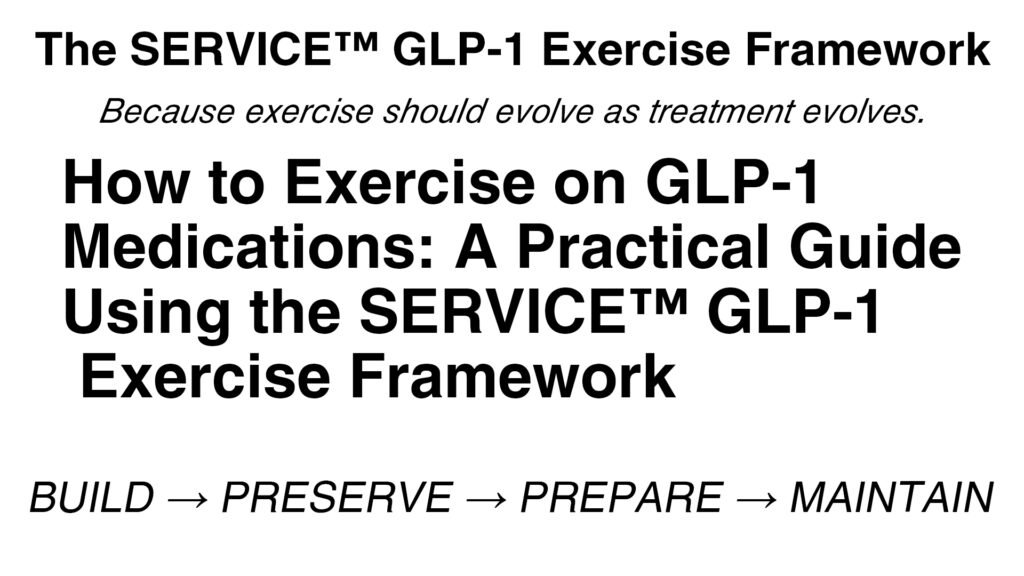
The SERVICE™ GLP-1 Exercise Framework provides a structured way to adjust exercise across these changing stages. The goal is not simply to recommend exercise for people taking GLP-1 medications, but to consider what type of exercise, how much, and how hard may be appropriate as the individual’s treatment stage and goals change.
BUILD → PRESERVE → PREPARE → MAINTAIN
BUILD → PRESERVE → PREPARE → MAINTAIN
This phase-based approach is particularly important because exercise recommendations for GLP-1 users are often presented as broadly similar throughout treatment. The SERVICE™ framework instead emphasizes that the role and emphasis of exercise can change from one phase to the next.
For more resources, visit out YouTube Channel Community Page. Our YouTube Channel Videos are coming soon! Subscribe to stay informed!
Interested in getting started with Exercise Physiology Coaching in-person? Complete the appropriate form below
Future Client or Patient Form → Healthcare Provider Referral Form →Why Does Exercise Matter During GLP-1 Treatment?
GLP-1-based medications can produce substantial weight loss. However, changes in body weight can include reductions in both fat mass and lean mass.
For example, a body-composition substudy from the SURMOUNT-1 trial found that participants receiving tirzepatide experienced substantial reductions in body weight, fat mass and lean mass over 72 weeks. Approximately 75% of the weight lost was fat mass and 25% was lean mass in that substudy. [1]
It is important to understand that lean mass is not the same thing as skeletal muscle. Lean mass measurements can include water, organs, connective tissue and other tissues in addition to muscle.
That is why the goal should not simply be “prevent all lean-mass loss.”
A more useful exercise goal is to support:
- Muscle strength
- Physical function
- Resistance-training capacity
- Physical activity
- Fitness
- Long-term independence
Research on weight loss more broadly supports resistance exercise as an important strategy for protecting fat-free mass and improving muscular strength.
A 2025 systematic review and meta-analysis of 25 randomized controlled trials found that adding resistance exercise to dietary weight loss protected against loss of fat-free mass and produced greater improvements in muscular strength compared with diet-only weight-loss approaches. [2]
This evidence helps explain why resistance training is an important component of the SERVICE™ GLP-1 Exercise Framework.
How the SERVICE™ GLP-1 Exercise Framework Guides Exercise
The SERVICE™ GLP-1 Exercise Framework is a four-phase, evidence-informed exercise framework:
BUILD
Establish the foundation.
The BUILD phase emphasizes learning how to exercise, developing movement competency, establishing consistency and improving exercise tolerance.
PRESERVE
Prioritize strength and physical capacity.
The PRESERVE phase places greater emphasis on resistance training and progressive exercise while body weight is changing.
PREPARE
Prepare for long-term independence.
The PREPARE phase focuses on maintaining exercise habits and physical capacity as treatment circumstances change.
MAINTAIN
Sustain strength, fitness and physical activity.
The MAINTAIN phase emphasizes long-term exercise habits rather than treating exercise as something that ends when a medication changes or weight loss goals are reached.
The framework is intended to help exercise evolve with the individual rather than forcing everyone to perform the same workout at every stage. [3]
What Exercise Should You Actually Do?
For a generally healthy beginner who has been cleared for exercise, a practical starting point is a combination of:
-
Full-body resistance training
-
Walking or other enjoyable aerobic activity
-
Gradual progression
-
Adequate recovery
-
Attention to how the body responds to exercise
Current U.S. physical-activity guidance recommends that adults work toward at least 150 minutes of moderate-intensity aerobic activity each week and muscle-strengthening activity on at least two days per week. Importantly, people who are inactive do not have to reach the full target immediately. Some physical activity is better than none, and activity can be increased gradually. [4]
For someone beginning exercise while taking a GLP-1 medication, the starting point should be based on current ability, not simply on the medication dose.
A General Beginner Full-Body Workout
The following is an example of a general beginner workout consistent with the BUILD-to-PRESERVE philosophy of the SERVICE™ GLP-1 Exercise Framework.
It is not an individualized medical or exercise prescription.
Perform 2 days per week
| Exercise | Sets | Repetitions |
|---|---|---|
| Sit-to-stand or bodyweight squat | 2 | 8–12 |
| Hip hinge | 2 | 8–12 |
| Wall or incline push-up | 2 | 8–12 |
| Resistance-band or machine row | 2 | 8–12 |
| Step-up | 1–2 | 8–10 each leg |
| Farmer carry or loaded carry | 2 | 20–30 seconds |
| Walking | — | 10–20 minutes |
Rest approximately 60–120 seconds between resistance-training sets, or longer if needed.
The objective is not to finish exhausted.
The objective is to perform the exercises with controlled technique, develop confidence and create a repeatable training stimulus.
What If You Feel 100%?
There may be days when you feel good, have good energy and are recovering well from previous workouts.
On those days, follow the planned workout.
If the prescribed repetitions feel manageable and your technique remains consistent, you can gradually progress the exercise.
For example:
Squat — 2 × 8
Then:
2 × 10
Then:
2 × 12
Once 12 repetitions can be performed comfortably with good technique, a modest increase in resistance may be appropriate.
You could then return to approximately 8 repetitions with the new resistance and gradually build again.
This is a simple example of progressive overload.
What Is Progressive Overload?
Progressive overload means gradually increasing the challenge placed on the body as your ability improves.
Progression can involve:
- Increasing repetitions
- Increasing resistance
- Adding a set
- Increasing range of motion
- Using a more challenging exercise variation
- Improving movement control
Progressive overload does not mean that every workout needs to be harder.
Sometimes the correct decision is to maintain the current workload.
Sometimes the correct decision is to reduce it.
The goal is gradual, sustainable progression.
When Should a Beginner Move to the Progressive-Overload Workout?
This is one of the most important questions in the SERVICE™ GLP-1 Exercise Framework.
The answer is not:
“As soon as you have few medication side effects.”
Medication tolerance is only one consideration.
A person may tolerate semaglutide or tirzepatide very well but still be a complete beginner who needs to learn basic resistance-training movements.
A better progression model is:
Exercise experience + movement competency + exercise tolerance + recovery = readiness to progress.
A beginner may be ready for more deliberate progressive overload when they can:
- Consistently complete their workouts.
- Perform the exercises with reasonably good technique.
- Recover appropriately between sessions.
- Complete the upper end of the prescribed repetition range.
- Handle the current resistance without excessive fatigue.
- Understand how hard the exercises should feel.
- Progress without significant increases in pain or other concerning symptoms.
At that point, the person can transition from primarily BUILDING the ability to exercise toward PRESERVING and progressively developing strength and physical capacity.
What If You Are Having a Low-Energy Day?
Not every workout day will feel the same.
GLP-1 treatment can occur alongside changes in appetite, food intake, gastrointestinal symptoms, energy and exercise tolerance.
The answer does not have to be:
“Skip everything.”
It also does not have to be:
“Push through no matter what.”
Instead, the workout can be modified.
The SERVICE™ Dial-Back Approach
Feeling good
Complete the planned workout.
Mild fatigue
Consider:
- Reducing the resistance slightly.
- Performing fewer repetitions.
- Taking longer rest periods.
- Reducing one set from selected exercises.
More noticeable fatigue
Consider:
- Using lighter resistance.
- Performing fewer total exercises.
- Choosing easier exercise variations.
- Shortening the cardio portion.
- Focusing on movement quality rather than progression.
Significant symptoms
If you are experiencing significant nausea, vomiting, dizziness, dehydration, unusual weakness or other concerning symptoms, exercise should not be treated as something you simply need to push through.
Stop or postpone exercise as appropriate and seek appropriate medical guidance when warranted.
The SERVICE™ GLP-1 Exercise Framework is designed to encourage exercise adaptation rather than forcing a predetermined workload regardless of how a person is responding.
What About Nausea?
Nausea can make exercise considerably less comfortable.
If nausea is mild and you otherwise feel well, you may find that reducing exercise intensity, extending rest periods or choosing easier activity is more appropriate than completing a demanding workout.
If nausea is significant, persistent or accompanied by vomiting, dizziness, dehydration or other concerning symptoms, exercise may need to be postponed and medical guidance may be appropriate.
The purpose of the framework is not to make someone exercise through significant symptoms.
The purpose is to provide a structure for adapting exercise appropriately.
Home Workout or Gym Workout?
The SERVICE™ GLP-1 Exercise Framework can be applied in either environment.
Home Workout
A home program can use:
- Body weight exercises
- A chair
- Resistance bands
- Dumbbells
- A backpack
- Household objects that can be safely loaded
- Walking outdoors
A home workout may be particularly useful for someone who is uncomfortable in a gym or wants to remove barriers to getting started.
Gym Workout
A gym program provides access to:
- Resistance machines
- Cable systems
- Dumbbells
- Barbells
- Cardio equipment
- More incremental resistance options
The gym can be particularly useful when someone is ready for structured progressive overload.
Neither environment is automatically better.
The best environment is often the one that allows someone to exercise consistently and progress appropriately.
Regular Beginner Workout or Progressive-Overload Workout?
A simple way to decide is:
Choose the regular beginner workout when:
“I am still learning how to exercise.”
This may apply if you are:
- New to resistance training.
- Learning exercise technique.
- Establishing consistency.
- Developing exercise tolerance.
- Uncertain about how much resistance to use.
Choose the progressive-overload workout when:
“I have built the foundation and I am ready to systematically get stronger.”
This may apply when you:
- Exercise consistently.
- Know the movements.
- Recover appropriately.
- Can complete your prescribed repetitions.
- Are ready to gradually increase resistance or another training variable.
Modify either program when:
“My current energy, recovery or symptoms do not support the planned workload.”
This is an important part of the SERVICE™ approach.
The workout is not supposed to control the person.
The program should respond to the person.
What About Semaglutide?
Semaglutide is a GLP-1 receptor agonist used in several clinical contexts, including chronic weight management.
For someone using semaglutide, exercise programming should focus on the same fundamental principles:
- Resistance training
- Aerobic activity
- Gradual progression
- Recovery
- Physical function
- Sustainable exercise habits
The appropriate exercise program depends on the individual’s experience, physical abilities, health status, goals and treatment response.
There is no need to create an entirely different type of resistance exercise simply because the person is taking semaglutide.
What About Tirzepatide?
Tirzepatide acts on both GIP and GLP-1 receptors and can produce substantial weight loss.
Body-composition findings from SURMOUNT-1 demonstrate that tirzepatide-associated weight loss included reductions in both fat mass and lean mass. [1]
That makes strength training and physical activity important considerations when developing a comprehensive exercise strategy.
Again, the exercise program should be individualized according to the person’s capabilities and response rather than determined solely by the medication.
Why Is Muscle Strength Important?
Muscle is about more than appearance.
Strength contributes to everyday physical function.
Think about:
- Getting out of a chair.
- Climbing stairs.
- Carrying groceries.
- Lifting objects.
- Getting down to the floor.
- Getting back up.
- Walking.
- Maintaining independence.
This is why the SERVICE™ GLP-1 Exercise Framework places emphasis on strength and physical function, rather than focusing exclusively on body weight.
Why Resistance Training?
Resistance training provides a direct stimulus to the muscles.
During weight loss, this matters because research supports resistance exercise as a way to help protect fat-free mass and improve strength.
The 2025 systematic review and meta-analysis mentioned earlier found that resistance exercise added during dietary weight loss protected against loss of fat-free mass and improved muscular strength compared with dietary weight loss without resistance exercise. [2]
That does not mean resistance training guarantees that someone will maintain all of their muscle.
It means resistance training is an important evidence-supported tool for supporting muscle and strength during weight loss.
What About Cardio?
Cardiovascular activity remains important.
Walking is an excellent starting point for many beginners because it is accessible and easy to adjust.
A simple progression might look like:
10-minute walk → 15-minute walk → 20-minute walk → 25-minute walk → gradually increasing toward a larger weekly amount as tolerated.
The CDC recommends that adults work toward at least 150 minutes of moderate-intensity aerobic activity per week, along with muscle-strengthening activity on at least two days per week. [4]
However, a beginner does not have to start at 150 minutes.
The appropriate starting amount depends on current fitness and ability.
Does the SERVICE™ Framework Replace Medical Care?
No.
The SERVICE™ GLP-1 Exercise Framework is designed to complement medical care, not replace it.
Exercise programming should be coordinated with appropriate healthcare guidance when medical conditions, significant symptoms, medication-related concerns or other limitations are present.
People with chronic conditions or disabilities may benefit from discussing appropriate exercise types and amounts with a healthcare professional or qualified physical-activity specialist. [5]
When Is a General Workout Not Enough?
A general exercise program can be an excellent starting point.
However, it cannot account for every person’s circumstances.
Individualized programming may be appropriate for someone with:
- Significant joint limitations.
- Previous injuries.
- Balance limitations.
- Cardiovascular limitations.
- Neurological conditions.
- Significant weakness.
- Mobility restrictions.
- Complex medical history.
- Exercise-related symptoms.
- Specific performance goals.
In these situations, the exercise program may need to be modified around the individual’s abilities and limitations.
Individualized SERVICE™ Exercise Physiology Coaching
Patrick Service, M.S., ACSM-EP, Exercise Physiologist and founder of YOUTRAINFITNESS®, developed the SERVICE™ GLP-1 Exercise Framework as an evidence-informed approach to organizing exercise considerations throughout changing stages of GLP-1 treatment.
YOUTRAINFITNESS® also provides individualized GLP-1 exercise physiology coaching for people who need exercise programming beyond a general workout.
An individualized program can consider:
- Exercise history
- Current fitness level
- Movement ability
- Health history
- Physical limitations
- Goals
- Exercise preferences
- Current treatment circumstances
- Exercise tolerance
This is particularly important when a general home or gym program does not adequately address the person’s needs.
About Patrick Service, M.S., ACSM-EP
Patrick Service is an Exercise Physiologist and founder of YOUTRAINFITNESS® in Durham, North Carolina.
His professional credentials include:
-
M.S.
-
ACSM Certified Exercise Physiologist (ACSM-EP)
-
ACSM Certified Personal Trainer (ACSM-CPT)
-
ACSM/ACS Certified Cancer Exercise Trainer
-
NASM Corrective Exercise Specialist
-
NASM Performance Enhancement Specialist
His professional biography documents 30+ years of professional experience and a background that includes exercise science, fitness programming, therapeutic recreation and specialized exercise training. [6]
Patrick developed the SERVICE™ GLP-1 Exercise Framework to provide an evidence-informed structure for considering how exercise can evolve throughout GLP-1 treatment.
The Big Picture
GLP-1 medications can be an important part of a person’s weight-management treatment.
But exercise has a different role.
Exercise can help address the physical side of the weight-loss journey by supporting:
Strength.
Physical function.
Fitness.
Muscle preservation.
Confidence with movement.
Long-term exercise habits.
The SERVICE™ GLP-1 Exercise Framework organizes those goals into four phases:
BUILD
Learn how to exercise and establish the foundation.
↓
PRESERVE
Progress strength and physical capacity while weight is changing.
↓
PREPARE
Build the habits and capacity needed for long-term independence.
↓
MAINTAIN
Continue strength, fitness and physical activity for the long term.
The framework does not require everyone to perform the same workout.
Instead, it provides a way to ask:
What can this person do now?
What can they tolerate?
Are they ready to progress?
How should the workout change when energy or exercise tolerance changes?
Does this person need individualized exercise programming?
That is the central idea behind the SERVICE™ GLP-1 Exercise Framework.
Don’t simply ask how much weight someone has lost. Ask how well they can move, how strong they are becoming, and whether they are building the physical capacity to live well during and beyond GLP-1 treatment.
Frequently Asked Questions
Can I exercise while taking a GLP-1 medication?
Many people can exercise while taking GLP-1 medications, but the appropriate exercise program depends on individual health, exercise experience, physical ability and treatment response. Beginners should start at an appropriate level and progress gradually.
Is strength training important when taking semaglutide or tirzepatide?
Resistance training is an important component of a comprehensive exercise strategy during weight loss. Research supports resistance exercise for protecting fat-free mass and improving strength during dietary weight loss. [2]
Should I exercise if I feel tired after taking my medication?
It depends on the severity of the fatigue and your overall condition. Mild fatigue may call for a lighter workout, while significant fatigue or other concerning symptoms may warrant postponing exercise and seeking appropriate guidance.
Should I use the regular workout or progressive overload?
Use the regular beginner workout if you are still learning the exercises or developing exercise tolerance. Consider progressive overload once you can consistently perform the exercises with good technique, recover appropriately and handle the current workload.
Does minimal medication side effect mean I should use progressive overload?
No. Medication tolerance is only one consideration. Exercise experience, movement competency, recovery and exercise tolerance also matter.
Can I do the SERVICE™ GLP-1 Exercise Framework at home?
Yes. The framework can be implemented with body weight exercises, resistance bands, dumbbells and other appropriate home equipment.
Can I use the SERVICE™ GLP-1 Exercise Framework in a gym?
Yes. Gym equipment can provide additional options for resistance training and gradual progressive overload.
Does the framework guarantee muscle preservation?
No. No exercise program can guarantee complete preservation of muscle or lean mass during weight loss. The framework is intended to support strength, physical function and preservation of lean tissue through evidence-informed exercise principles.
What if I have a physical limitation?
A general program may need to be modified. If you have significant physical limitations, medical conditions or specific exercise needs, individualized exercise physiology guidance may be appropriate.
Does SERVICE™ replace my doctor or medical team?
No. The SERVICE™ GLP-1 Exercise Framework is designed to complement medical care, not replace it.
References
4. Adding Physical Activity as an Adult — CDC
5. Chronic Conditions & Disabilities Activity — CDC
6. Patrick Service, M.S., ACSM-EP — Professional Vita — YOUTRAINFITNESS®
Additional SERVICE™ GLP-1 Exercise Framework resource
The SERVICE™ GLP-1 Exercise Framework: A 4-Phase Exercise Plan for Weight Loss, Muscle Preservation, and Building Healthy Habits
Disclaimer
This article provides general educational information about exercise during GLP-1 treatment. It is not individualized medical advice, a diagnosis or a substitute for care from a qualified healthcare professional.
Exercise programs should be adapted to the individual’s health status, exercise experience, physical abilities, goals and response to treatment. Individuals with medical conditions, significant symptoms or exercise limitations should obtain appropriate professional guidance before beginning or changing an exercise program.
THE SERVICE™ GLP-1 Exercise Framework Resources
| 01. THE SERVICE™ GLP-1 Exercise Framework Learn how the different phases of the framework can help you through your GLP-1 therapy | 06. WHAT HAPPENS AFTER GLP-1 MEDICATIONS Learn some helpful strategies for achieving success after GLP-1 medication |
| 02. PHASE 1: REDUCED DOSE EXERCISE PLAN Learn how to establish the proper foundation for the journey ahead | 07. THE SERVICE™ GLP-1 Exercise Framework Clinical Exercise Referral A clinician's guide to evaluate our services for clients/patients. |
| 03. PHASE 2: FULL DOSE EXERCISE PLAN Learn how maximize muscle preservation and fitness progress | 08. THE SERVICE™ GLP-1 Exercise Framework Clinical Handout Download a one page summary with QR Code to read full document |
| 04. PHASE 3: TAPERING OFF GLP-1 EXERCISE PLAN Learn how to protect results during transition | 09. THE SERVICE™ GLP-1 Exercise Framework Patient-Facing Handout Download a one page summary of what to expect with our exercise program |
| 05. PHASE 4: OFF GLP-1 EXERCISE PLAN Learn how to achieve long-term health and lifestyle Independence | 10. GLP-1 EXERCISE PHYSIOLOGY COACHING IN DURHAM NC Learn how to preserve muscle, build strength, support weight loss, and create lifelong exercise habits |
This Program is Part of our Exercise Physiology Services in Durham NC
Link: Certified Exercise Physiologist in Durham NC